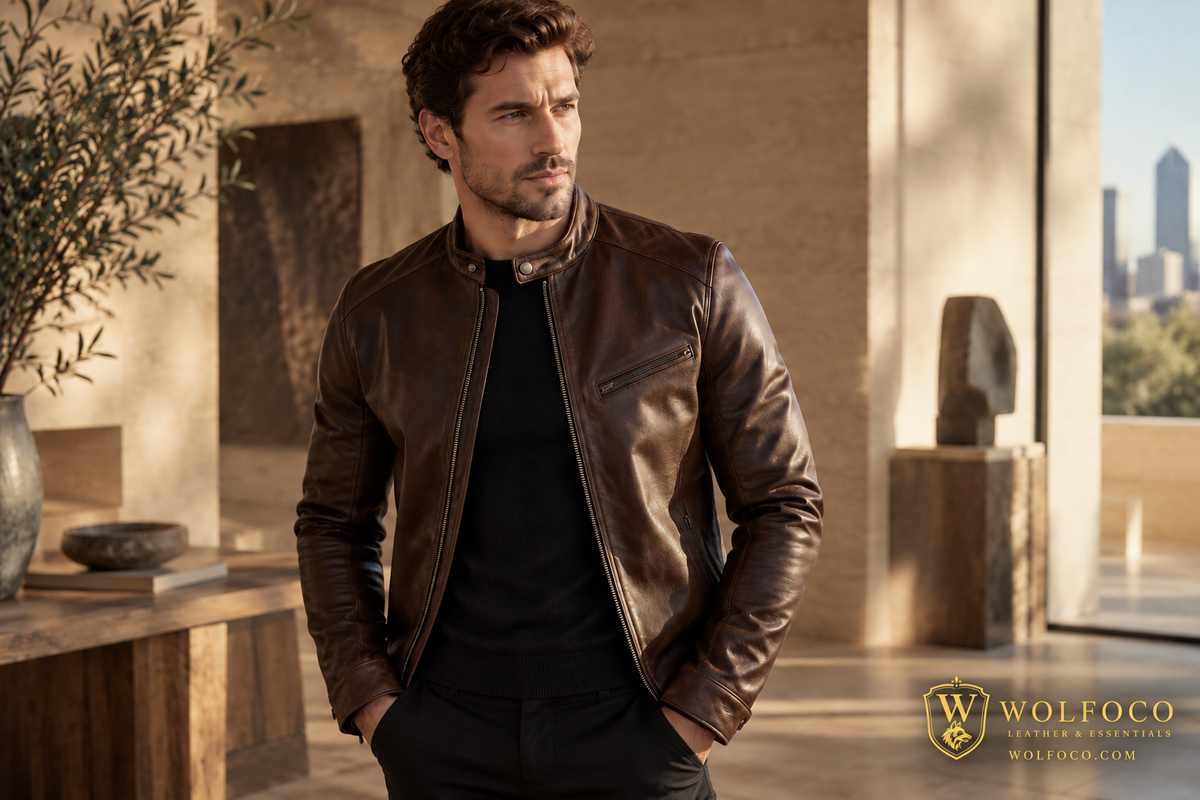

A balanced leather-jacket fit follows the shoulders, leaves functional room through the chest and finishes cleanly at the wrist.
Quick answer: A leather jacket should fit snug, never tight. The shoulder seam sits at your shoulder edge, the zip closes over a T-shirt or thin knit without pulling, sleeves end at the wrist bone, and you can reach forward freely. Leather softens and moulds with wear, but it will not stretch a full size.
A leather jacket is not like a pair of jeans. It will not shrink to you, and it will not stretch a full size bigger no matter how long you wear it. What you feel in the mirror on day one is, within a small margin, what you will feel in year five. That is why fit matters more with leather than with almost anything else in your wardrobe — and why guessing by the letter on the label (S, M, L) is the single most common mistake buyers make.
This guide walks through exactly how a leather jacket should fit, point by point: shoulders, chest, sleeves, back and hem. It covers the tight-or-loose question directly, gives separate fit guidance for men and women, explains how fit changes by jacket style, and shows you how to choose the right size from your own measurements before you order.
How should a leather jacket fit? The 5-point fit check
Before the detail, here is the whole answer in one pass. Run these five checks on any leather jacket — in a store, at home, or against a size chart — and you will know within a minute whether the fit is right.
| Check | Good fit | Warning sign |
|---|---|---|
| 1. Shoulders | Seam finishes at the natural shoulder edge | Seam hangs down the arm or cuts inward |
| 2. Chest & zip | Closes smoothly; flat hand slides inside | Zipper strains, X-shaped pulling across the front |
| 3. Sleeves | Cuff reaches the wrist bone at rest | Hands disappear, or wrist is exposed at rest |
| 4. Back & reach | Reaching forward feels free, no deep tension lines | Horizontal creases pull hard across the back |
| 5. Hem & length | Ends at belt line to upper hip (style-dependent) | Rides up when sitting or bunches across the lap |
The right fit also depends on the silhouette, the leather and how you plan to wear the jacket. A slim cafe racer is supposed to sit closer than a bomber. A motorcycle-style jacket can feel structured without limiting normal movement. A jacket bought for winter layering needs more ease than one worn over a T-shirt. Those differences matter far more than picking the size you "usually" wear.
Should a leather jacket be tight or loose?
Neither extreme. A leather jacket should be snug through the body with full freedom of movement — close enough that the shoulders and chest follow your shape, loose enough that you can zip it over your normal layer, take a deep breath and reach forward without the back pulling hard.
Here is the practical verdict by area:
- Shoulders: exact, never sloped. This is the one measurement that cannot be fudged — a seam sitting on the shoulder edge is right; a seam sliding down the arm is a size too big.
- Chest: close but closable. Zip it fully over the layer you will actually wear. You should fit a flat hand inside the chest without forcing it. If the zipper distorts or the leather pulls into X-shaped wrinkles, it is too tight.
- Waist and hem: follow the silhouette. A cafe racer should skim; a bomber is meant to hold a little volume above its ribbed band.
- Mobility: the deciding test. Sit down, reach forward as if holding a steering wheel, raise both arms. Some lift is normal in a close jacket; pain, neck pressure or a hem that climbs dramatically is not.
One warning that saves a lot of returns: do not buy a jacket that is uncomfortably tight today because "leather stretches." Leather relaxes modestly where it flexes — elbows, chest, back — but shoulder width, sleeve length and the underlying pattern do not transform. Buy for how it feels now. We cover this in depth in our guide to what to do when a leather jacket is too tight and in whether you can stretch a leather jacket.
How should a leather jacket fit in the shoulders and chest?
The shoulder is the most important starting point because it controls how the sleeves hang and how the upper body moves. On a conventional set-in sleeve, the shoulder seam should meet the point where your shoulder begins to curve downward. A seam far below that point usually means the jacket is oversized, unless the design is intentionally dropped-shoulder. A seam sitting inside the shoulder can make the sleeve pull upward and create pressure across the upper back.

A traditional shoulder seam should align near the natural shoulder edge; intentional oversized cuts are the exception.
Look at the jacket from the front, side and back. Small creases are normal because leather is a natural material. Strong diagonal lines from the neck toward the armhole suggest tension. A hollow pocket of fabric above the chest can indicate excess width or an incompatible shoulder slope. Do not assume a thick leather jacket will permanently reshape enough to correct a poor shoulder fit.
The zip-close test
Zip or button the jacket fully over your normal layer, then take a slow, deep breath. You should be able to slide a flat hand inside the chest without forcing it. Mild initial structure is normal; painful pressure, a distorted zipper or pronounced X-shaped wrinkles are not. At the other extreme, a front that hangs away from the body with large folds at the sides means the jacket is too large, no matter how comfortable it feels.
How should a leather jacket fit women?
A women's leather jacket should follow three points — bust, waist and hips — in that order of priority. Fit the bust first, because it is the least forgiving: the jacket must close over the fullest part of the bust without the zipper pulling apart or horizontal creases radiating from the closure. If it strains at the bust, no amount of styling fixes it.
From there, check the waist and hips. A well-cut women's jacket is shaped, not boxy: it should skim the waist rather than hang straight from the bust, and the hem should sit cleanly at the hip without flaring out or riding up when you sit. Shoulder seams follow the same rule as any jacket — right at the shoulder edge — and sleeves should finish at the wrist bone with your arms relaxed.
Length is a style choice, but proportion is not. A cropped jacket should end at its intended point and stay there when you reach forward; a longer moto or blazer cut should clear the widest part of the hip without catching. For a full walkthrough of cuts, closures and lengths, see our women's leather jacket style and fit guide, and if you are between sizes, our women's leather jacket size guide maps body measurements to finished jacket measurements.
How should a men's leather jacket fit?
A men's leather jacket should sit square on the shoulders, close cleanly over the chest and stomach, and end around the belt line. The classic errors are sizing up for "room" — which just moves the shoulder seam down the arm and makes the whole jacket look borrowed — and judging fit with the jacket open, which hides chest strain that appears the moment you zip it.
Run the same five checks: seam at the shoulder edge, zip closes without X-pulling, sleeves to the wrist bone, a clean back when you reach forward, and a hem at the belt line or upper hip depending on style. If you carry your layers underneath — a hoodie in winter, a T-shirt in summer — test with the heavier one, because a jacket that only fits over a T-shirt is a jacket you will only wear in May.
Sleeve length and the reach test
For most everyday leather jackets, the sleeve should finish at or just beyond the wrist bone when your arms rest naturally. Use the knuckle test as your cross-check: with your arms slightly bent, as if holding a steering wheel, the cuff should still cover the wrist and approach the base of the thumb — for riding-style jackets, that extra coverage is deliberate. The cuff should never swallow the hand at rest or leave the wrist bare.

Test reach, elbow bend and cuff position — not only how the sleeves look while standing still.
Then move. Reach forward, raise each arm, bend both elbows, sit down with the jacket zipped. Some lift is expected in a close-fitting jacket, but the hem should not climb dramatically and the collar should not press into your neck. The lining should glide without twisting. If mobility is poor even when the chest measurement seems adequate, the armhole height, upper-arm width or back width is usually the real issue — not the chest size.
Where should a leather jacket end?
A classic cafe racer or biker jacket commonly ends near the belt line or upper hip. A leather bomber finishes at the waist with its ribbed band. A trucker jacket may sit around the upper hip, while a leather blazer or coat is intentionally longer. The best length balances the design with your torso and what you wear it with.
Check the length standing and sitting. A short jacket should not open an unintended gap at the back whenever you move, and a longer jacket should not bunch heavily across the lap. If you plan to wear yours with high-rise trousers, dresses or longer knitwear, test those proportions before deciding — hem placement is where "technically fits" and "looks right" most often disagree.
How to choose the right size leather jacket
Choosing the right size is a measuring exercise, not a guessing one. Letter sizes vary between brands and even between styles from the same brand, so work from your numbers. You need six measurements, taken with a flexible cloth tape over the layer you will wear most:
- Chest: around the fullest part, under the arms and across the shoulder blades, tape level.
- Shoulder width: across the back from one shoulder edge to the other, following the natural curve.
- Sleeve length: from the shoulder edge, over a slightly bent elbow, to the wrist bone.
- Back length: from the prominent bone at the base of the neck to where you want the hem.
- Waist: where the jacket will close, not necessarily at the narrowest point.
- Upper arm: around the fullest part of the bicep, arm relaxed.

Measure the chest over the layer you expect to wear most often and keep the tape parallel to the floor.

Then compare against the finished garment measurements, not your body numbers directly. A finished jacket needs ease — room beyond your body — so you can breathe and move; how much depends on the design and the leather. If a product page does not list finished measurements, ask for them. Between sizes? Size for the shoulders and bust first, and let the waist be the adjustable variable. Our step-by-step guide to measuring for a leather jacket shows each measurement with photos if you want to double-check your technique.
How fit changes by leather jacket style
Cafe racer
A cafe racer has a clean collar, minimal bulk and a close, streamlined body. It should follow the torso without stretching the zipper, and the armholes need enough room for forward reach — particularly if you commute or ride.
Biker / moto
A biker jacket carries more hardware, lapels and asymmetry. Judge the fit open and closed, because the front overlap changes the silhouette; hardware should lie flat rather than being pulled out of alignment.
Bomber
A bomber allows more room through the body and finishes with a fitted waistband. A little volume is intentional, but the shoulders should stay controlled and the waistband should not ride up continuously.
Blazer
A leather blazer should close smoothly, follow the lapel line and leave room through the upper back. Evaluate it over the shirt or light knitwear you will actually wear underneath.
Cropped
A cropped jacket should end at its intended visual point without creeping shorter during normal reach. Sleeve and shoulder balance matter even more here, because the abbreviated hem makes proportion errors obvious.
Should a leather jacket be tight at first?
A new leather jacket can feel structured and will soften somewhat with wear — but "break-in" should never be used to justify the wrong size. Leather relaxes modestly at points of repeated movement; shoulder width, sleeve length and overall pattern do not transform reliably. Buy for functional comfort now, not for a hoped-for future shape.
Leather type and thickness change the starting feel. Softer lambskin drapes sooner than substantial cowhide, and finish, lining and panel construction all affect movement. Because the Wolfoco range includes different hides and silhouettes, compare each product's stated specifications rather than applying one rule to every jacket.
Seven common leather jacket sizing mistakes
- Choosing only by S, M, L — or by the label in an old jacket.
- Measuring over a bulky layer you will not normally wear.
- Confusing body measurements with finished garment measurements.
- Ignoring shoulder position because the chest happens to close.
- Checking sleeve length only with arms hanging straight.
- Assuming leather will stretch enough to correct a tight fit.
- Approving a custom order before the final measurements are written down clearly.
Done measuring? Put the numbers to work.
Check the finished measurements on the Wolfoco jacket style you like — or go made-to-measure and we build to yours. Shop men's leather jackets → · Shop women's leather jackets →
Quick fit chooser: tight, regular or relaxed?
- Choose a close (snug) fit if you want a sharp café-racer or biker silhouette and mostly wear it over T-shirts and shirts.
- Choose a regular fit if this is your one everyday jacket and you want room for a light knit or hoodie in cooler months.
- Size up one if you are between sizes, have broad shoulders or a fuller chest/bust, or plan to layer heavier sweaters.
- Stay at your true size if the shoulders already sit right and only the waist feels slightly firm — that usually eases with wear.
- Go custom if standard sizes fit your shoulders but not your sleeves or torso length — see what a custom leather jacket costs.
Shop by fit: men’s leather jackets · women’s leather jackets · all leather jackets · matching couple jackets.
Shipping & returns (Wolfoco policy): ready-to-ship orders arrive in 3–7 days via USPS, UPS or FedEx; custom and made-to-order pieces take 5–14 days. Standard items have a 30-day return window with a 100% refund; custom items are final sale except for defects. Details: shipping information · refund policy.
Frequently asked questions
Can I wear a hoodie or sweater under a leather jacket?
Yes, if you buy for it. A close-fit biker or café racer is cut for a T-shirt or thin knit; for a hoodie or chunky sweater, choose a regular fit or size up one so the zip closes without strain and the sleeves don’t ride up.
Should I size up or down in a leather jacket?
Size up if you are between sizes and want to layer, or if the shoulders feel tight. Size down only if the shoulders are already too wide and you wear the jacket over thin layers. Shoulders and chest decide the size; the waist and sleeves can be adjusted or eased.
How tight should a leather jacket be when you first buy it?
Firm but comfortable: you should be able to zip it, cross your arms and drive without the back straining. Expect it to soften and mould slightly over the first weeks of wear, not to grow a size.
Should a leather jacket be tight or loose?
Snug, not tight. A leather jacket should follow your shoulders and chest closely enough to look shaped, while still zipping smoothly over your normal layer and letting you breathe, sit and reach forward freely. If the zipper strains or the back pulls hard when you reach, it is too tight; if the shoulder seams slide down your arms, it is too loose.
How should a leather jacket fit women?
Fit the bust first: the jacket must close over the fullest part of the bust without the zipper pulling or creases radiating across the front. Then check that it skims the waist rather than hanging boxy, and that the hem sits cleanly at the hip. Shoulder seams belong at the shoulder edge, and sleeves should finish at the wrist bone.
How should a men's leather jacket fit?
Square on the shoulders, clean over the chest, and ending around the belt line. The shoulder seam should sit at the edge of the shoulder, the zip should close without X-shaped pulling, and sleeves should reach the wrist bone. Judge it zipped, not open — most fit problems only show once the jacket is closed.
How do I choose the right size leather jacket?
Measure your chest, shoulders, sleeve, back length, waist and upper arm over the layer you will wear most, then compare those numbers with the jacket's finished garment measurements — not the letter size. Fit shoulders and bust first; if you are between sizes, that is the measurement that decides.
Will a leather jacket stretch if it is tight?
Only slightly. Leather softens and relaxes at flex points like the elbows and chest, but it will not stretch a full size, and shoulder width and sleeve length never change. A jacket that is painfully tight today will still be the wrong size in a year — exchange it rather than waiting for it to give.
Where should leather jacket sleeves end?
At the wrist bone with your arms resting naturally. When you bend your arms as if holding a steering wheel, the cuff should still cover the wrist and approach the base of the thumb — riding styles are cut slightly longer for exactly this reason. Sleeves that cover the hand at rest are too long; sleeves that bare the wrist at rest are too short.
Should a men's leather jacket be tight or loose?
Snug, not tight. On a man the shoulder seam should land at the edge of the shoulder, the zip should close over a T-shirt or thin knit without pulling, and you should be able to cross your arms and reach forward without the back straining. If it only feels right with nothing underneath, it is too small; if the chest balloons when zipped, it is too big.
How do women measure for a leather jacket?
Use a soft tape over a thin top: measure the bust at its fullest point, the natural waist, the hips if the jacket falls past the waist, shoulder width from seam point to seam point across the back, and sleeve length from the shoulder point to the wrist bone with the arm slightly bent. Compare those numbers with the product size chart rather than relying on your usual letter size. Our measuring guide walks through each step.
Related: Shop all Wolfoco leather jackets · Matching leather jackets for couples · Leather jacket too tight?
Editorial note: This guide gives general fit guidance. Exact product specifications and customization options are confirmed on each Wolfoco product page, or in writing before a custom order goes into production.