The short answer: to change a belt buckle with snaps, flip the belt over, pull the leather fold apart at each snap until it pops, slide the old buckle off, then slide the new buckle on with its face pointing out and its prong through the slot in the leather. Put the keeper back between the two snaps, press each snap closed until it clicks, and tug the buckle hard to check it. The whole job takes about a minute and needs no tools. If your belt has small screws instead of snaps, you need a flat screwdriver. If it is stitched or riveted, the buckle is not meant to come off at home.
That covers most people who land here. The rest of this guide is the detail that keeps the job from going sideways: how to tell what kind of belt you actually have, why the width of the buckle matters more than its style, what to do when a snap is too stiff to open, and how to size a strap if you are buying one just to wear the buckles you already own. We sell a snap-on strap with no buckle, The Swap, so we get these questions a lot, and we have tried to answer them the way we would over the counter.

Step zero: flip the belt over and look at the buckle end
Before you pull on anything, turn the belt so you are looking at the back of the strap right where it wraps around the buckle. That little fold of leather tells you everything. There are four common ways a buckle is held on, and each one comes off differently.
| What you see on the back | What it is | Can you swap the buckle? | What you need |
|---|---|---|---|
| One or two round metal studs | Snap-on fold | Yes, by hand | Your fingers |
| Small screw heads with a slot | Chicago screws | Yes | A small flat screwdriver |
| No hardware on the strap; the end disappears into the buckle | Ratchet or clamp buckle | Yes, through a release on the buckle | Sometimes a small screwdriver |
| A line of stitching or a pair of rivets | Stitched or riveted fold | Not at home | A leather repair shop |
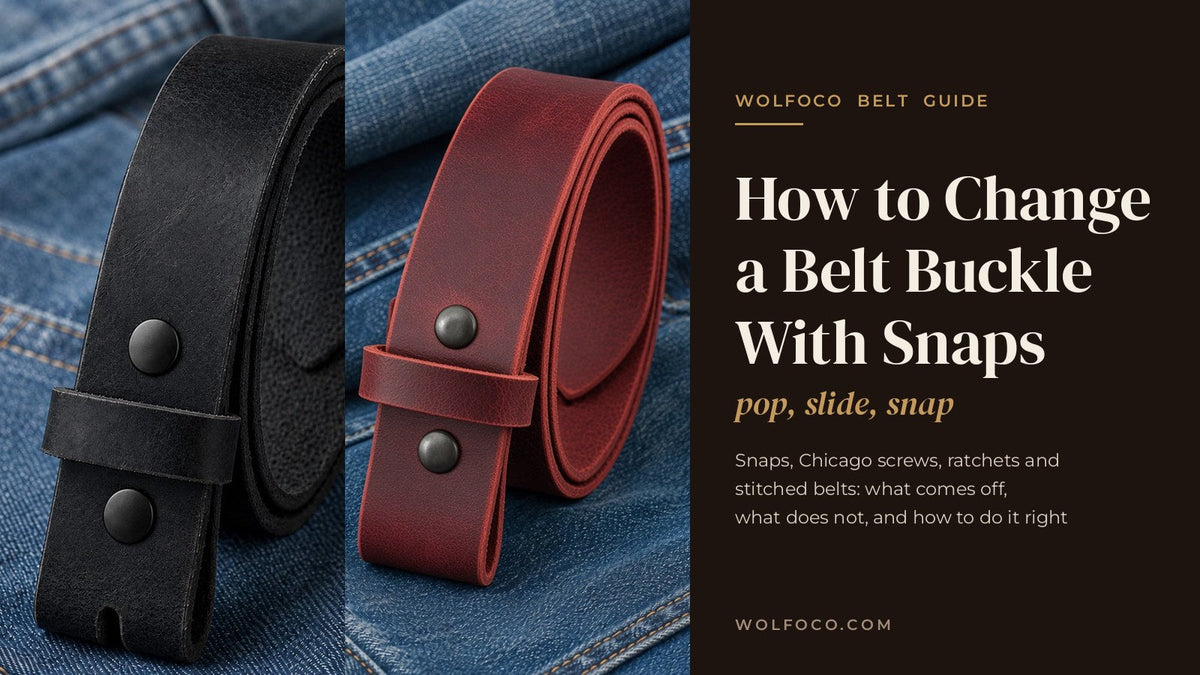
Snaps are the easiest to spot. They look like the round studs on a denim jacket, usually two of them, spaced a couple of inches apart, with a small leather loop (the keeper) sitting between them. On our Swap strap you can see both snaps on the outside of the fold, and the keeper rides in the gap between them. When you see that arrangement, you are holding a belt that was designed to have its buckle changed.
Stitching is the one to respect. If the fold is sewn shut, the maker meant the buckle to be permanent. You can cut the thread and resew it, but that is a job for someone with an awl, waxed thread and a little patience, not a butter knife on the kitchen table. Prying at a stitched or riveted fold usually tears the leather right at the point where it carries the most load.
How to change a snap-on belt buckle, step by step
Here is the process we walk people through. It assumes a standard prong buckle going onto a snap-on strap, which is the most common setup for interchangeable buckles.
1. Pop both snaps
Hold the belt with the back facing you. Pinch the leather on each side of the first snap, as close to the stud as you can get your fingertips, and pull the two layers apart with a short, firm tug. Do not peel from the end of the strap. Peeling bends the leather around the snap and, over time, can stretch the hole. Pull straight apart, right at the snap. Do the same for the second snap.
New snaps are stiff. That is normal and it is actually what you want, because a snap that pops open easily on day one is a snap that pops open when you sit down in the truck. If yours will not budge, slide a thumbnail or the edge of a credit card between the layers right next to the stud and lever gently. Never use a screwdriver blade against the leather face; it will leave a mark you will see every time you put the belt on.
2. Slide the old buckle off
With both snaps open, the fold relaxes and the buckle slides off the end of the strap. Before you set it aside, look at which way the prong pointed and which side of the buckle faced out. It sounds obvious, but this is where most people get turned around. Take a quick photo with your phone if you are going to be swapping a few buckles in a row.
The keeper may slide off at the same time. Keep track of it. It is easy to lose and annoying to replace.

3. Put the new buckle on, prong through the slot, keeper in place
Lay the strap face down. Slide the new buckle onto the folded end so that the front of the buckle will face out when you wear it. If it is a prong buckle, push the prong through the small slot cut into the fold. That slot is there so the prong can pivot. If you skip it, the prong ends up pinned under the leather and the belt will not fasten.
Now thread the keeper back on. It belongs between the two snaps, so put it on before you close the second one. If you close both snaps first and then remember the keeper, you start over. Ask us how we know.
4. Snap it closed and test it
Fold the leather back over and line up each stud with its socket. Press with your thumb until you feel and hear the click. Then do the part people skip: hold the strap in one hand and the buckle in the other and give it a good hard pull. If something is going to let go, you want it to happen in your living room, not halfway through a wedding reception.
Last check: put the belt on. The buckle should sit flat, the prong should swing freely, and the tail should run toward the keeper in the direction you normally wear it. Most men wear the tail running to their left, but go with whatever you are used to.
How to change a buckle held on with Chicago screws
Chicago screws are the two-piece screws you see on a lot of heavier casual and work belts. One half is a post with a threaded hole, the other half is a short screw with a slotted head. They are reliable and easy to service, and the only real trick is keeping the post from spinning while you turn the screw.
- Lay the belt flat with the screw slots facing up.
- Fit a flat screwdriver snugly in the slot. A loose fit chews up the slot, and once that happens the screw is a pain to get out.
- Press the strap firmly against the table so friction holds the post still, then turn counterclockwise. If the post spins anyway, hold it from the other side with a thumb wrapped in a rubber band or a strip of tape for grip.
- Pull both screws, open the fold, slide the buckle off and the new one on, prong through the slot.
- Push the posts back through the holes, thread the screws in and snug them. Snug, not cranked. Overtightening crushes the leather and can strip the thread.
Put the screws in a cup or a dish while you work. They are tiny and they love rolling under the fridge.
Ratchet belts, reversible belts and ring belts
Not every belt follows the snap-or-screw pattern, and a couple of popular styles work differently enough that they are worth a quick note.
Ratchet belts have no holes in the strap. The end feeds into a clamp inside the buckle, usually released with a small lever or a screw on the back. Changing the buckle means releasing that clamp and sliding the strap out. These are also the belts you size by cutting the strap at the buckle end, so be sure before you trim.
Reversible belts usually use a swivel buckle so you can flip the strap from black to brown. Our Duality uses a swivel gunmetal plate buckle on a cut-to-fit strap; the buckle comes off so you can trim the strap to your size, then goes back on. If you are curious how the flip actually works, we wrote a full explainer on how a reversible belt works.
Ring belts are a different animal entirely. A double O-ring or D-ring belt has no prong and no holes; the rings are the buckle. There is nothing to swap, but there is a technique to wearing one, and it trips a lot of people up. Our guide on how to wear a double O-ring belt covers it, and The Loop is ours.
The one measurement that matters: buckle width
When a buckle swap goes wrong, it is almost never the snaps. It is width. A buckle made for a 1.5 inch strap will slide around loose on a 1.25 inch strap and will not go onto a 1.75 inch strap at all. Before you buy a buckle, or a strap for buckles you already own, measure.

Here is how to measure it properly. Do not measure the outside of the buckle frame, because a big western plate can be three or four inches across and still only take a 1.5 inch strap. Measure the inside opening where the leather passes through, or measure the width of the strap the buckle came on. Belts are usually sold in a handful of standard widths:
- About 1 inch: slim fashion belts, often worn with dresses, high-waisted trousers or slimmer jeans. Our Slimline sits here.
- 1.25 inch (32mm): the classic dress width for suit trousers. The Sovereign is 1.25 inch.
- 1.5 inch (38mm): the everyday width for jeans and chinos, and the width a lot of interchangeable buckles are made for. The Ranger is 1.5 inch, and The Swap is approximately 1.5 inch.
- 1.75 inch and up: heavier work and western belts. Check your belt loops before going this wide; plenty of jeans will not take it.
A loose buckle is not just a cosmetic problem. When the opening is wider than the strap, the buckle tilts every time you move, the prong pulls against one edge of the hole, and the hole starts to stretch into an oval. A snug fit spreads the load across the whole width of the leather. If you want more on how width relates to trouser loops and outfits, our belt size, width and buckle guide goes deeper.
Why bother with a snap-on strap at all?
Fair question. Most people own one or two belts and never think about the buckle again. But there are a few kinds of people who end up with a snap-on strap and are glad they did.
The buckle collector. Rodeo buckles, trophy buckles, a granddad's old silver plate, a buckle picked up at a show in Fort Worth or on a road trip. Buckles tend to outlive the belts they came on, and a good strap lets you actually wear them instead of keeping them in a drawer. If western buckles are your thing, our western leather belt guide covers widths and how they sit with jeans and boots.
The one-belt traveler. One strap and two buckles take up less room in a bag than two full belts. A plain buckle for dinner, something with more character for the weekend.
The guy whose strap wore out before the buckle did. This one happens all the time. The leather cracks at the holes he uses most, but the buckle is solid brass and still looks great. With snaps, you move the buckle to a new strap and keep going.
The gift giver. If someone you know already has a buckle that means something, a new strap to wear it on is a thoughtful gift that costs less than replacing the whole belt.

Choose this if…
Here is the honest version, product by product, for anyone deciding what to buy after reading this.
- Choose The Swap ($69) if you already own buckles you want to wear, or you like changing your look without buying a whole new belt. It is a premium leather snap-on strap, approximately 1.5 inch wide, in Black, Crazy Horse Brown, Blood Red and Antique Brown, sizes 30 to 48. The buckle is not included, so you bring your own.
- Choose The Ranger ($85) if you want a finished casual belt for jeans and chinos and do not care about swapping buckles. It comes with an antique brass roller buckle and is 1.5 inch wide in cognac or dark brown.
- Choose The Sovereign ($79) if you need a black dress belt for suits, interviews and weddings. Most interchangeable buckles are too big and too casual for dress trousers anyway.
- Choose The Duality ($95) if what you really want is black and brown in one belt, without carrying a second buckle.
- Choose The Keepsake Belt ($109) if you are buying a gift and want initials on it.
Or browse them all side by side in The Belt Collection.
Sizing a strap for buckles you already own
Sizing a snap-on strap works the same as sizing any belt: order about 2 inches above your pant waist. If you wear a 34 inch jean, order a size 36 strap. That puts you on or near the middle hole, which leaves room either way for heavier or lighter trousers and for the inevitable post-holiday adjustment.
If you are not sure of your pant size, there is a more reliable way. Take a belt you already wear and like the fit of. Lay it flat. Measure from the fold where the leather wraps around the buckle bar to the hole you use most. That number is your belt size. It works no matter what the tag in your jeans says, and it tends to be more accurate, because jeans sizes drift from brand to brand.

One thing to keep in mind with interchangeable buckles: they are not all the same depth. A slim prong buckle adds very little length to the belt, while a big plate buckle hooks on differently and can change where the belt lands on you by a bit. If you swap between very different buckles, the hole you use may shift by one. That is normal and it is one more reason to size so you land near the middle hole, not on the last one.
If you end up between sizes, go up. A strap that is a little long just puts the tail past the keeper. A strap that is too short is a strap you will not wear.
Common mistakes we see
- Buying a buckle by looks alone. Check the strap width it is made for before you fall in love with it.
- Forcing a stitched fold. If there are no snaps and no screws, stop. Take it to a leather repair shop or wear the belt as it is.
- Putting the buckle on upside down. The prong should point toward the holes, and the front of the buckle should face away from you when you wear it.
- Losing the keeper. It goes between the snaps. Put it on before you close the second one.
- Peeling snaps open from the end of the strap. Pull straight apart, right at the stud, to protect the leather around the hole.
- Overtightening Chicago screws. Snug is enough. A drop of clear nail polish on the thread keeps them from backing out and still lets you open them later.
Caring for the snaps and the leather
Snaps are simple hardware and do not ask for much. Keep them dry when you can; if the belt gets soaked, open the snaps and let the fold dry out flat so water does not sit trapped between the layers. Do not oil the snaps themselves, because conditioner on the metal just collects lint. Condition the leather a couple of times a year with a small amount of a good leather conditioner, worked in with a soft cloth and wiped off. Less is more. Too much makes the strap soft and floppy, especially at the fold where the buckle hangs.
If a snap ever gets loose enough to open on its own, that is worth a message to us rather than living with it. Every Wolfoco belt is covered by our craftsmanship warranty, and standard items come with a 30-day, 100% refund.
Shipping and returns
We ship from Prosper, Texas to the US and internationally with USPS, UPS or FedEx, with DHL Express where it is offered at checkout. Ready-to-ship US orders typically arrive in 3 to 7 business days, and your exact shipping cost is shown at checkout before you pay. International customers can see live carrier rates for their country by entering an address at checkout; duties and taxes are the buyer's responsibility. Full details, including international delivery estimates, are on our Shipping Information page. Returns are covered in our Refund and Returns Policy, and if you have a question that is not answered here, get in touch.
Frequently asked questions
How do I change a belt buckle with snaps?
Turn the belt over, pull the leather apart right at each snap until it pops, slide the old buckle off, slide the new buckle on with the prong through the slot and the front facing out, put the keeper between the snaps, then press both snaps closed until they click. Tug the buckle firmly to make sure it is secure.
Can you change the buckle on any belt?
No. You can change it easily on belts that use snaps, Chicago screws or a ratchet clamp. If the leather is stitched or riveted around the buckle, the buckle was meant to be permanent, and changing it is a job for a leather repair shop.
Do I need tools to change a snap-on buckle?
No. Snap-on buckles come off by hand. A thumbnail or the edge of a credit card helps with a stiff new snap. You only need a flat screwdriver if the buckle is held on with Chicago screws.
How do I know what width buckle I need?
Measure the width of your strap, or the inside opening of the buckle where the leather passes through, not the outside of the frame. Common widths are about 1 inch, 1.25 inch for dress belts and 1.5 inch for jeans belts. The buckle opening and the strap should match.
Will a 1.5 inch buckle fit The Swap?
The Swap is approximately 1.5 inch wide and its snap-on end is made to fit most standard 1.5 inch interchangeable buckles. Check that your buckle's opening is made for a 1.5 inch strap before you order.
Does The Swap come with a buckle?
No. The Swap is a strap only, so you can use a buckle you already own. If you want a complete belt with a buckle, look at The Ranger or the rest of The Belt Collection.
Where does the keeper go on a snap belt?
Between the two snaps. Slide it on after the buckle and before you close the second snap, otherwise you will have to open the fold again.
What size snap-on strap should I order?
Order about 2 inches above your pant waist, so a 34 inch waist takes a size 36. You can also measure a belt you already own from the buckle fold to the hole you use most.
My new snaps are really stiff. Is that normal?
Yes. New snaps are firm on purpose so they do not open while you wear the belt. Pull the layers straight apart right next to the stud rather than peeling from the end. They loosen slightly with use.
Can I put a western trophy buckle on a snap-on strap?
Usually, yes, as long as the buckle is made for the same strap width. Many western and trophy buckles are made for 1.5 inch straps, but check yours before you buy.
Do you ship belts outside the United States?
Yes. We ship to Canada, the UK, the EU, Australia, New Zealand and more. Enter your address at checkout to see live rates; duties and taxes are the buyer's responsibility. See our Shipping Information page for delivery estimates.
The bottom line
Flip the belt over first. If you see snaps, the buckle comes off by hand in about a minute: pop, slide, snap, test. If you see screws, grab a flat screwdriver. If you see stitching, leave it alone. Match the buckle width to the strap and you will avoid nearly every problem people run into. And if you have a drawer full of buckles with nothing to wear them on, The Swap was made for exactly that. For gift ideas across the whole range, see our leather belt gift guide or our guide to the best leather belt for jeans and boots.