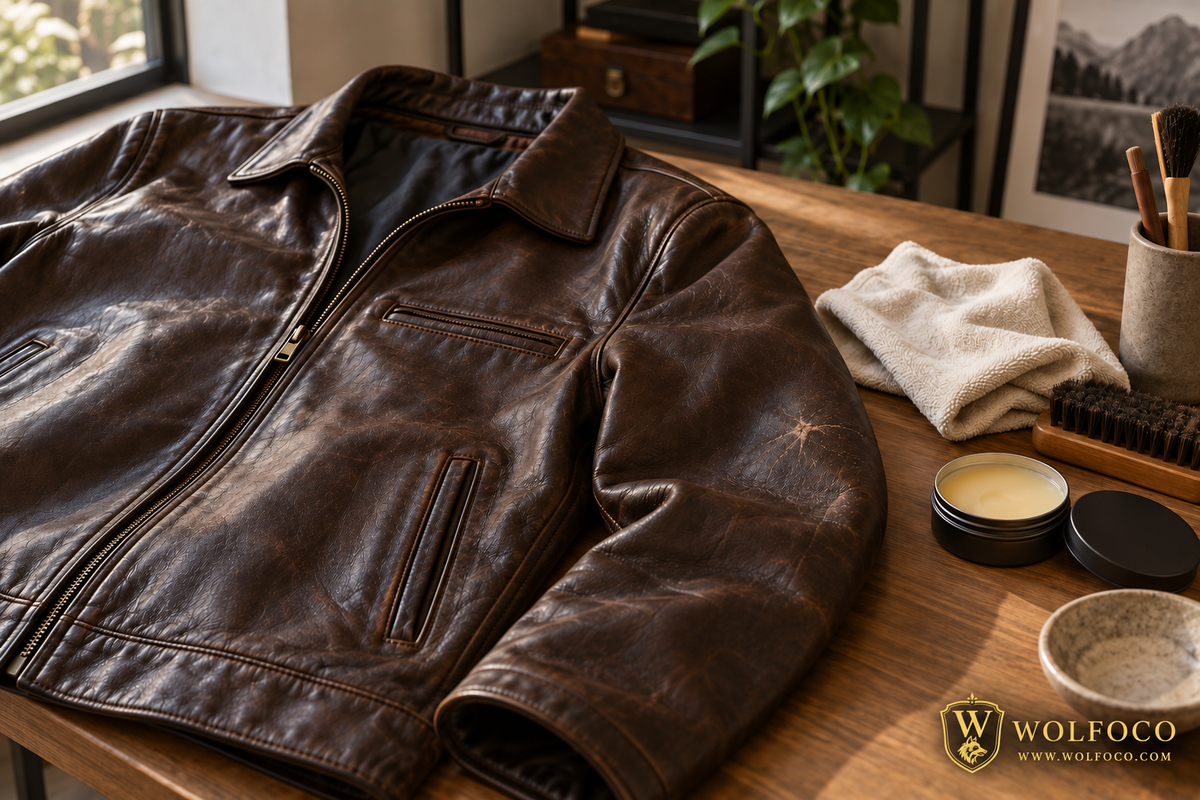
Quick answer: First identify whether the mark is a surface scuff, a scratch through the finish, a cut, or a moisture stain. Do not rub, heat, saturate or recolor the area immediately. Blot moisture, let leather dry naturally, check the maker’s care guidance, and patch-test any treatment. Deep cuts, peeling finishes, dye loss and valuable pieces belong with a leather-care professional.

Identify the problem before you act
| Condition | What it may look like | Safest first response |
|---|---|---|
| Surface scuff | Light transfer or disturbed finish without an opening | Dry soft cloth; stop if color transfers |
| Shallow scratch | Fine line in the finish | Maker-approved care after a hidden patch test |
| Deep cut or tear | Open fibers, lifted edge or structural damage | Do not glue casually; consult a professional |
| Fresh water | Droplets or damp area | Blot and air-dry evenly |
| Dried water spot | Ring, tide line or changed sheen | Seek product-specific advice before wetting again |

What to do with a fresh water spill
- Remove contents and transfer any dye-prone fabric away from the wet area.
- Blot gently with a clean absorbent white cloth.
- Do not rub the boundary of the wet area.
- Shape the item naturally and let it dry at room temperature.
- Keep it away from radiators, hair dryers and direct sun.
- After it is fully dry, assess any remaining change before applying products.

Can conditioner remove scratches?
Conditioner may reduce the visual contrast of some light scuffs on compatible finished leather, but it is not a universal scratch eraser. It can darken leather, change sheen or spread dye. Never apply a heavy layer directly to the visible mark. Confirm compatibility, patch-test in a hidden area, and use the smallest amount needed.

What not to use
- Household cooking oils or petroleum jelly
- Alcohol, acetone or hand sanitizer
- Magic erasers or abrasive pads
- Shoe polish of an unverified color
- Hair dryers, heaters or direct intense sun
- Super glue on a visible tear
Internet repair tricks often omit the leather type and finish. A method that appears acceptable on protected pigmented leather can permanently mark aniline, suede or nubuck.
When professional restoration is appropriate
Seek specialist assessment for tears, punctures, peeling coatings, extensive dye loss, mold, unknown stains, soaked lining, strong odor or high-value/vintage items. Ask what result is realistic: restoration may reduce visibility without making damage completely disappear.

Prevention that actually helps
Store leather in a breathable, climate-stable space; avoid overloading bags; keep pens and liquids in separate pouches; rotate high-contact items; and follow the maker’s conditioning schedule rather than treating on an arbitrary calendar. Read our storage guide and cleaning and conditioning guide.
Frequently asked questions
Can I rub a scratch with my finger?
Gentle warmth may shift oils on some pull-up leathers, but rubbing can worsen delicate finishes. Identify the leather and stop if appearance changes unpredictably.
Does water permanently ruin leather?
Not always. Outcome depends on leather type, finish, saturation and drying. Prompt blotting and natural drying reduce avoidable damage.
Can I use shoe polish on a leather jacket?
Only if the manufacturer specifically approves a compatible product. Unmatched pigment can stain clothing and create an uneven finish.
How do I fix peeling leather?
Peeling may involve a failing coating or synthetic surface rather than a simple scratch. It requires diagnosis; conditioner will not rebuild a peeling layer.
Should I condition immediately after a spill?
No. Allow the item to dry fully and assess it first, then follow product-specific care guidance.
Continue learning: compare leather grades, review color behavior, or browse Wolfoco’s real catalog.