
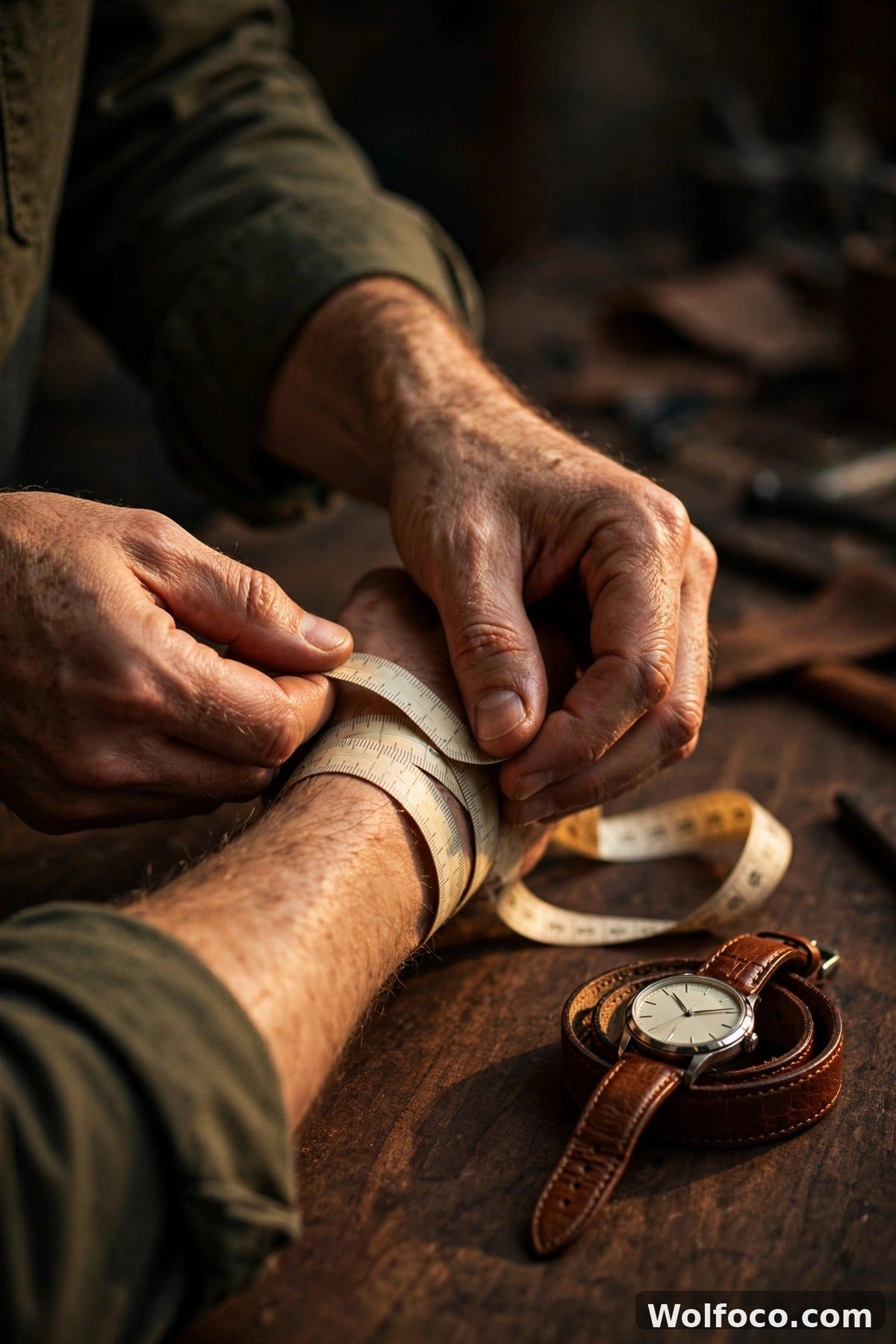

Quick answer: Wrap a soft measuring tape snugly around your wrist just below the wrist bone and read the number in millimeters — that is your wrist size. Match it to a strap length (small, regular, or long), then measure the gap between your watch's lugs for the lug width. Two numbers, two minutes, perfect fit.
There is a special kind of frustration in ordering a beautiful leather watch strap, waiting for it to arrive, and discovering it is either flopping around your wrist or squeezing it like a tourniquet. The strap was fine. The measurement was wrong.
The good news: measuring your wrist takes about two minutes, and once you know your two numbers — wrist size and lug width — you will never order the wrong strap again. Here is how to do it right, with three methods depending on what you have on hand.
Where Exactly to Measure
Measure just below the wrist bone — the bony bump on the outside of your wrist. This is where a watch naturally sits, and it is the spot every strap size chart assumes. Measuring over the bone or halfway up your forearm gives you a number that does not match how the strap will actually be worn.
Keep your hand relaxed and flat while you measure. Do not flex your wrist or make a fist; both change the circumference by several millimeters, and several millimeters is the difference between a strap that fits and one that does not.
Method 1: Soft Measuring Tape (Best)
If you own a tailor's soft measuring tape, this is the one to use. Wrap it around your wrist just below the bone, snug but not tight — you should be able to slide one finger under the tape. Read the number where the tape meets itself. That is your wrist size in millimeters.
Write the number down immediately. People are remarkably bad at remembering a measurement they took thirty seconds ago, and "I think it was around 180" is how wrong straps get ordered.

A soft tape wrapped snugly just below the wrist bone — the gold standard measurement.
Method 2: String and a Ruler (No Tape Needed)
No measuring tape? A piece of string, a strip of paper, or even a phone charging cable works. Wrap it around your wrist at the same spot, mark where it overlaps with a pen, then lay it flat against a ruler and read the length in millimeters.
The trick is keeping the string snug while you mark it. If it slides around, your mark drifts, and your measurement drifts with it. Hold the overlap point firmly between thumb and forefinger before marking.

String and a ruler: the no-tools method that works just as well.
Method 3: Measure a Strap That Already Fits
If you own a watch strap that fits perfectly, you already have the answer. Unbuckle it, lay it flat, and measure from the end of the strap (not counting the buckle) to the hole you normally use. That hole-to-end distance is your ideal strap length.
This method is especially handy when buying the same style again — if your current 120/80mm strap fits, ordering another 120/80 is a safe bet regardless of what your wrist circumference says.
Reading the Number: Wrist Size to Strap Length
Your wrist circumference maps to a strap size range. Most leather straps come in three lengths, and here is how they generally line up:
- Small / Short — wrists roughly 150–175mm (about 6–6.9 inches). Strap halves around 110/70mm.
- Regular / Medium — wrists roughly 175–200mm (about 6.9–7.9 inches). Strap halves around 120/80mm. This fits most men.
- Long / XL — wrists roughly 200–225mm (about 7.9–8.9 inches). Strap halves around 130/90mm.
Between sizes? Size up rather than down. A strap that is slightly long can use a different hole; a strap that is too short has nowhere to go. And remember the one-finger rule: once fastened, you should be able to slide one finger — comfortably, not forcefully — between the strap and your wrist. Real leather also relaxes a millimeter or two in the first weeks of wear, so a strap that starts just snug usually becomes perfect — but one that starts loose only gets looser.

The one-finger rule: snug enough to stay put, loose enough to breathe.
The Second Number: Lug Width
Wrist size tells you the strap length. Lug width tells you whether the strap will physically attach to your watch. The lugs are the small protrusions on the watch case that the strap sits between — measure the gap between them in millimeters with a ruler or caliper.
Common lug widths are 16, 18, 20, 22, and 24mm, with 20mm and 22mm covering most men's watches. A 20mm strap will not fit 22mm lugs, and a 22mm strap crammed into 20mm lugs will bunch and wear unevenly. If you cannot measure precisely, check your watch's specifications — lug width is almost always listed.

The gap between the lugs — measure it before you order anything.
What NOT to Do
A few mistakes account for most bad strap purchases. Do not measure over your wrist bone — it inflates the number. Do not measure with your fist clenched or your wrist bent. Do not guess your lug width by eye; two millimeters is invisible until the strap does not fit. And do not assume your new strap should be the same length as your old one if the old one never fit right in the first place.
Also: measure in the afternoon or evening if you can. Wrists swell slightly through the day, and a strap measured on a cool morning can feel tight by dinner.

Once you know your two numbers, choosing between leathers is the fun part.
A strap that fits starts with leather worth wearing.
Frequently asked questions
What is the average wrist size for a watch strap?
Most adult men's wrists fall between 170 and 200mm (about 6.7 to 7.9 inches), which is why "regular" length straps are the default everywhere. Women's wrists are commonly 140 to 170mm. But averages are a poor substitute for your own measurement — it takes two minutes and removes all guesswork.
How do I know my watch's lug width without calipers?
A standard ruler works fine for 18, 20, and 22mm — the differences are visible at that scale. You can also look up your watch model's specifications online, where lug width is nearly always listed. As a last resort, many jewelers will measure it for free in under a minute.
Should a leather watch strap be tight or loose?
Snug, not tight. You should be able to slide one finger under the strap without forcing it. Too tight and the leather stretches and wears prematurely; too loose and the watch slides around, which wears the strap holes unevenly.
Do leather watch straps stretch?
Yes, slightly. A quality leather strap relaxes a millimeter or two in the first weeks of wear as it molds to your wrist. This is why a strap that feels just snug on day one usually becomes perfect — but a strap that starts loose will only get looser.
What if I am between strap sizes?
Size up. A slightly longer strap simply uses a different adjustment hole, while a too-short strap has no fix. If you are between lengths, also consider the taper — a strap that narrows more aggressively can feel longer on the wrist than its listed length suggests.
Can I measure my wrist with a phone app?
Some apps claim to do this with the camera, but they are unreliable — perspective and distance distort the result. The string-and-ruler method takes the same two minutes and gives you a number you can trust. Save the apps for something else.
Measuring for a watch strap uses the same principle as measuring for a leather jacket: the right number, taken at the right spot, beats guessing every time. And if you are shopping for the watch lover in your life, our personalized leather gifts guide covers how to get the sizing right when the wrist is not yours to measure — plus lead times so it arrives on schedule. For anything made to your exact measurements, see our custom ordering guide.
Ready to put those two numbers to work? Browse Wolfoco's personalized leather accessories →

