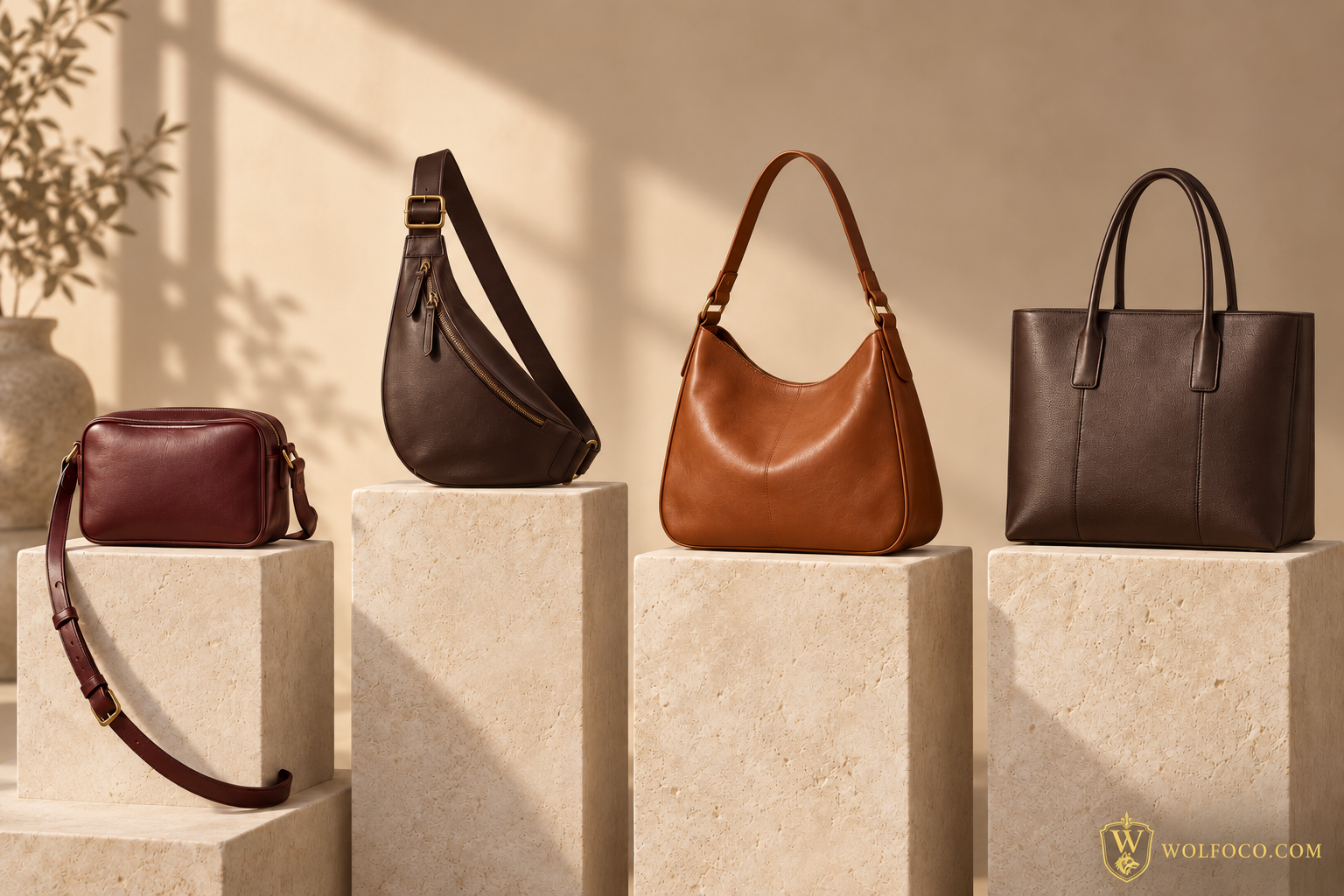
Quick answer: Choose a crossbody for secure hands-free daily carry, a sling for compact travel access, a shoulder bag for easy reach and a tote for maximum workday capacity. The right bag is determined by what you carry, how long you carry it, which hand must remain free and whether you need a secure closure.

Bag comparison
| Bag | Capacity | Carry | Best use | Main tradeoff |
|---|---|---|---|---|
| Crossbody | Small–medium | Long strap across torso | Daily essentials, city travel | Can bounce if overfilled |
| Sling | Small–medium | Single strap front/back | Transit, walking, quick access | Asymmetric weight |
| Shoulder | Small–medium | Under one arm | Everyday and polished outfits | May slip from shoulder |
| Tote | Medium–large | Twin handles | Work, laptop, shopping | Heavier and often less hands-free |
Crossbody bag: balanced security
A crossbody uses a long strap to place the bag against the opposite hip or front torso. It keeps both hands free and distributes the bag more securely than a short shoulder strap. Look for sufficient strap adjustment, reinforced anchor points and an opening that faces the body. A compact crossbody is ideal for phone, wallet, keys and travel documents; loading it with a tablet and bottle may make it swing or pull.

Sling bag: fastest compact access
A sling is usually narrower and shaped to rotate from the back to the chest. It suits commuting, airports and long walks when you need more than pockets but less than a day bag. Check whether the strap can switch sides, whether the zipper remains accessible in the chosen orientation and whether the back surface is comfortable against clothing.

Shoulder bag: easy reach and polished proportion
A shoulder bag hangs from one medium or short strap and is easy to open without removing it. It can feel dressier than a technical sling, and soft crescent shapes sit naturally beneath the arm. Handle drop is critical: too short for a coat, the bag becomes awkward; too long, it may swing. A wider strap distributes weight more comfortably.

Tote bag: capacity and organization
A tote is the natural option for laptops, documents, water bottles and layered daily essentials. The best work tote has a supported base, a secure top, strong handles and interior zones that keep dense objects from shifting. Published internal dimensions matter more than a generic “fits laptop” statement. For a deeper checklist, see the best leather tote for work and travel guide.

Use this five-question decision test
- What must fit? List exact devices and everyday items.
- How long will you carry it? Weight matters more over a commute than a short dinner.
- Do you need both hands free? Favor crossbody or sling.
- How secure must the opening be? Zippers offer more control than an open top.
- Which clothing will sit beneath the strap? Test with a coat as well as a shirt.
Measurements to verify
- external and internal width, height and depth;
- strap length and adjustment range;
- handle drop;
- opening width;
- empty weight;
- device-sleeve dimensions;
- maximum intended load, if supplied.
Frequently asked questions
Is a sling the same as a crossbody?
No. Both cross the torso, but a sling is typically narrower and designed to rotate between back and front, while a crossbody hangs more like a conventional bag at the hip or torso.
Which bag is safest for travel?
A close-fitting zipped crossbody or front-worn sling offers useful control, though no bag replaces normal awareness.
Which bag is best for shoulder pain?
Comfort is personal; lighter loads and wider, adjustable straps help. A backpack distributes weight more evenly than any one-shoulder bag.
Can a shoulder bag be worn crossbody?
Only when the strap is long and adjustable enough and the bag’s shape sits comfortably across the torso.
What size tote fits a laptop?
Compare the exact laptop dimensions with the internal sleeve and opening; screen size alone is not enough.
Which silhouette is most versatile?
A medium zipped crossbody handles the widest range of casual daily situations, while a structured tote is stronger for work.
Capacity note: Confirm measurements and materials on the individual product page; silhouettes and size names are not standardized.