
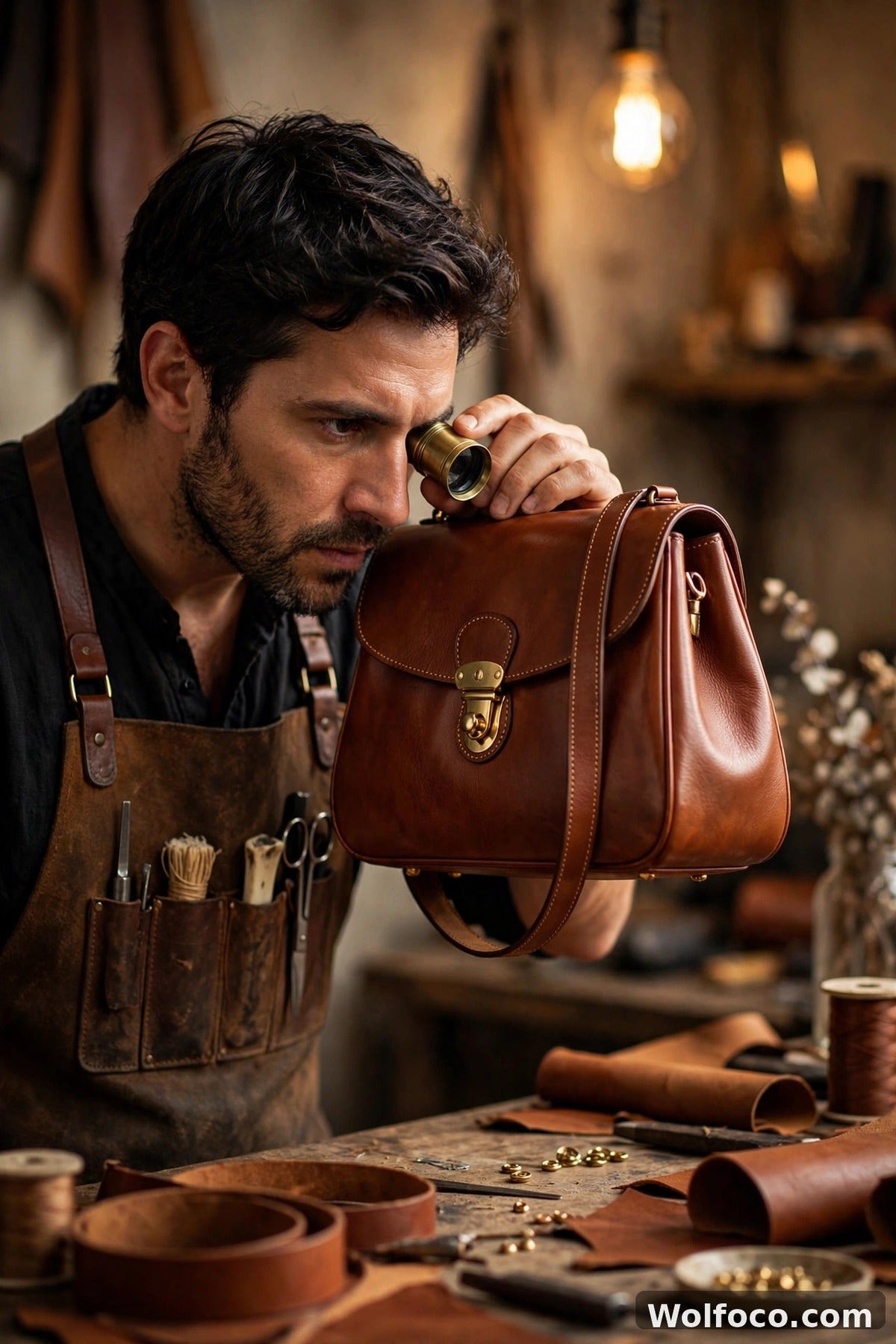

Quick answer: To spot a fake leather bag, check the stitching density and straightness, look for smooth painted edges instead of raw fibrous layers, feel for solid heavy hardware, and inspect the lining and logo plate. Real leather smells rich and earthy; fakes smell like chemicals or plastic. No single test is enough — use all six together.
A "genuine leather" handbag that starts peeling at the corners after three months. A "designer" tote whose zipper teeth grind like a coffee mill. If you've been burned by a fake leather bag, you're not alone — and if you're shopping for one right now, the stakes feel high because a good bag isn't cheap.
Here's the problem with most fake-spotting advice online: it's written for jackets. Bags have their own anatomy — stitching under tension, edge paint, hardware, linings, brand plates — and fakes fail in bag-specific ways that a jacket guide will never teach you. These six tests are the ones bag makers actually use when they pick up a bag and decide, in about thirty seconds, whether it's the real thing.
Test 1: Read the Stitching
Stitching is where cheap bags confess first. Real leather bags are stitched to survive years of being yanked, stuffed, and swung — so the stitching is dense, straight, and even. Count roughly: quality bags run 7 to 9 stitches per inch along stress seams. Fakes often manage 4 or 5 loose ones, and the line wanders.
Look specifically at the handles and strap attachments, where the load is greatest. On a real bag you'll see backstitching or reinforced box stitching at stress points. On a fake, you'll see single straight seams that are already pulling, or worse, glue doing the structural work with stitching as decoration. Pull gently on a handle seam — if the stitches gap and you see adhesive, walk away.

Hand saddle-stitching with waxed thread — the kind of seam work that holds for decades.
Test 2: Check the Edges
This is the fastest tell in the book, and it takes five seconds. Find any cut edge of the leather — the side of a strap, the edge of a flap, the rim of a pocket. On a quality leather bag, edges are burnished or painted: smooth, sealed, slightly glossy, uniform in color.
On a fake, the edge tells the truth the surface hides. You'll see raw, fibrous layers — sometimes visibly separating, like the pages of a cheap paperback. Bonded leather and PU show a foamy or fabric middle layer sandwiched between thin coatings. If the edge looks like it was cut with dull scissors and left to fray, the "leather" is a coating over something else.

Sealed, painted edge on the left; raw, fibrous layers on the right. Five seconds, no tools needed.
Test 3: Feel the Grain
Run your thumb across a broad panel. Real leather grain is gloriously inconsistent — pores of slightly different sizes, subtle wrinkles, areas that are a touch smoother or rougher. It feels alive because it was. Fake leather grain is embossed with a repeating pattern, and once you know to look for the repeat, you can't unsee it: the same pore cluster, stamped over and over like wallpaper.
Press the surface with your fingertip. Real leather wrinkles finely around the pressure point, like skin, and the creases fade when you release. Fake leather either doesn't wrinkle at all (too stiff, plastic-like) or creases in a way that stays put. Temperature helps too — real leather warms to your hand; synthetics stay oddly cool or feel clammy.

Natural, irregular grain on the left; stamped, repeating pattern on the right.
Test 4: Weigh the Hardware
Pick up the bag by its hardware — the clasp, the zipper pull, the buckle. Quality hardware has heft: solid brass or solid zinc alloy feels substantial in your hand. Fake-bag hardware is hollow, plated plastic, or paper-thin stamped metal. It feels like a toy.
Work the zippers. A good zipper glides with a smooth, damped action and the teeth mesh precisely. Cheap zippers grind, catch, and have visible gaps between teeth. Check the engraving on clasps and zipper pulls too — real hardware has crisp, evenly deep engraving; fakes have shallow, blurry stamping where the logo looks slightly melted. And look at the back of every rivet and snap inside the bag: clean, finished backs mean care; sharp, rough, unfinished backs mean corners were cut.

Solid brass hardware has weight and crisp engraving — hollow hardware is a dead giveaway.
Want a bag that passes every test on this page?
Wolfoco bags are cut from genuine leather, saddle-stitched, edge-painted, and fitted with solid hardware — the real thing, made to be carried for decades. Shop Leather Bags →
Start with the Genuine Leather Tote Bag or the Burgundy Leather Backpack.
Test 5: Inspect the Lining, Logos, and Brand Plates
Open the bag and look inside — this is where counterfeiters stop trying. A quality leather bag has a lining that fits like it was made for the bag: clean seams, no loose threads, pockets that are actually usable, and edges that are bound or turned rather than left raw. The lining material itself should feel substantial — cotton twill, suede, or quality synthetic — not the tissue-thin polyester that crackles.
Smell the interior. Real leather bags smell like leather all the way through; fakes smell strongest inside, where the chemical off-gassing of PU and adhesives concentrates. If opening the bag hits you with a wave of plastic or glue smell, the exterior "leather" is almost certainly coated fabric. Also check how the lining is attached: glued-in linings that bubble or peel at the corners are a red flag; stitched-in linings are a green one.
Then study any logo stamp, embossed mark, or metal brand plate with your phone's zoom. On authentic bags, logos are centered, level, and consistent — the font matches the brand's official typeface, letter spacing is even, and embossing is a uniform depth. On fakes, you'll find plates mounted crooked, fonts that are close-but-not-quite, uneven embossing depth, and misspellings in the fine print that nobody proofread. Metal plates should be solid and firmly riveted; if the plate flexes, feels like foil, or is held on with visible glue, that's your answer.
Test 6: The Smell Test
The oldest test is still one of the best. Real leather has a rich, earthy, slightly sweet smell — tanned hide, natural oils, nothing harsh. It's distinctive enough that experienced buyers can identify it blind. Fake leather smells like a chemistry set: plastic, vinyl, glue, or a sharp chemical tang that catches in your throat.
Two caveats. First, some real bags are heavily treated or stored in plastic, which can mute the smell temporarily — air it out and check again. Second, a few high-end synthetics are now scented to mimic leather, so never use smell as your only test. But as one of six checks, it's remarkably reliable: if it smells like a new shower curtain, it isn't leather.

A real leather tote ages beautifully — the patina is the reward for buying the real thing.
What NOT to Do When Checking a Bag
Don't do the burn test on a bag you own or are about to buy — it's destructive, it voids returns, and modern synthetics can be engineered to char like protein fibers anyway. Don't trust the label alone: "genuine leather" is legally one of the lowest leather grades, and labels are the easiest thing in the world to fake. Our guide to what "genuine leather" really means breaks down the whole grade ladder.
Don't assume price equals authenticity in either direction. Plenty of overpriced bags are bonded leather with a luxury markup, and plenty of fairly priced bags from small makers are the real thing. And don't judge by weight alone — some excellent lightweight leathers exist, and some fakes are loaded with heavy hardware to feel premium. Judge the whole bag: stitching, edges, grain, hardware, lining, logos, smell. Fakes can fake one or two of these. They can't fake all six.
Frequently asked questions
How can you tell if a leather bag is real or fake?
Check six things: stitching density and straightness, sealed painted edges versus raw fibrous edges, natural irregular grain, heavy solid hardware with smooth zippers, a well-finished lining with crisp centered logos, and the rich earthy smell of real leather. No single test is definitive — real bags pass all six, fakes fail at least two or three.
What is the easiest way to spot a fake leather handbag?
Look at the cut edges. Genuine leather bags have smooth, burnished or painted edges; fakes show raw, fibrous, separating layers — sometimes with a visible fabric or foam core. It takes five seconds and requires no tools, and it's the test counterfeiters most consistently fail.
Does real leather peel?
Real full-grain or top-grain leather does not peel — it scuffs, creases, and develops patina. Peeling is the signature failure of bonded leather and PU ("vegan leather"), where a plastic coating flakes off its fabric backing. If your "leather" bag is peeling, it was never real leather to begin with.
Can you tell fake leather by smell?
Usually, yes. Real leather smells rich, earthy, and slightly sweet; fake leather smells like plastic, vinyl, or chemical glue — strongest inside the bag. It's a strong signal but not infallible, since some synthetics are scented and some real bags are stored in plastic, so always combine it with the visual and touch tests.
Is "genuine leather" on a bag label a guarantee of quality?
No — "genuine leather" is one of the lowest grades of real leather, made from the leftover layers of the hide, and the label is easy to counterfeit. What matters is the grade (full-grain and top-grain are the best), the construction, and the six physical tests above — not the words on the tag.
What should I check first when buying a secondhand leather bag?
Start with edges and stitching — they're the hardest to fake well and the fastest to check. Then work the hardware, smell the interior, and examine the logo plate with your phone's zoom. For jackets, the same principles apply with jacket-specific tells — see our guide on how to spot a fake leather jacket.
Understanding leather grades makes every one of these tests sharper — our full-grain vs top-grain vs genuine leather guide explains what each grade actually is and why it matters most in bags, which flex and abrade every day.
Buy the bag, not the gamble.
Every Wolfoco bag is genuine leather with sealed edges, dense stitching, solid hardware, and a finished lining — built to pass all six tests, today and in ten years. Shop Leather Bags →

