

Quick answer: Real leather has an organic smell, irregular pores that never repeat, and a fibrous raw edge — while fake leather smells like plastic, shows a perfectly uniform grain pattern, and reveals a fabric or foam backing at the edges. Run the smell, pore, edge, water-drop, label, and price tests below and you'll catch nearly every fake before you pay for it.
You've found the jacket. The cut is perfect, the photos look incredible, and the listing says "genuine leather" in bold letters. Then it arrives — and something feels off. The surface looks too perfect. It smells like a shower curtain. That sinking feeling is the most expensive part of buying a leather jacket blind.
Here's the good news: you don't need a lab to tell real leather from fake. Your nose, your fingertips, and a drop of water can do what marketing copy can't. These seven hands-on tests are the same ones leather workers use when a hide comes through the door — adapted for the moment you're standing in a shop, or staring at a screen, deciding whether to trust a jacket.
Test 1: The Smell Test
Pick up the jacket and breathe in close to the leather — not the lining, the leather itself. Real leather has a deep, rich, organic scent. It's warm and slightly musky, the smell of a good shoe store or an old library chair. It smells like an animal hide because that's what it is.
Fake leather smells like what it's made of: plastic, chemicals, or vinyl. Some fakes have a sweet, paint-like odor; others smell faintly of fish or glue from the adhesives holding the layers together. If the first thing that hits you is a chemical smell, trust your nose.
One caveat: the smell test is strongest on a new jacket. Real leather's scent fades over years, and some manufacturers add leather-scented finishes to synthetics. So never stop at this test — it's your first filter, not your verdict.
Test 2: The Pore Pattern Test
Get close to the surface — really close — and look at the grain. Real leather is animal skin, and skin is gloriously imperfect. The pores are irregular: different sizes, uneven spacing, little scars and wrinkles that never repeat. No two square inches look exactly alike.
Faux leather is stamped by a machine. Look for a pattern that repeats — the same little pebble shape, marching in neat rows across the whole panel. If the grain looks too perfect, too uniform, too consistent, you're looking at embossed plastic.

Left: genuine full-grain leather with natural, irregular pores. Right: faux leather with a stamped, repeating pattern.
Also run your thumb across it. Real leather feels warm and slightly yielding, with texture that changes as you move. Faux leather feels cooler, slicker, and oddly consistent — like touching a well-made dashboard.
Test 3: The Edge Test
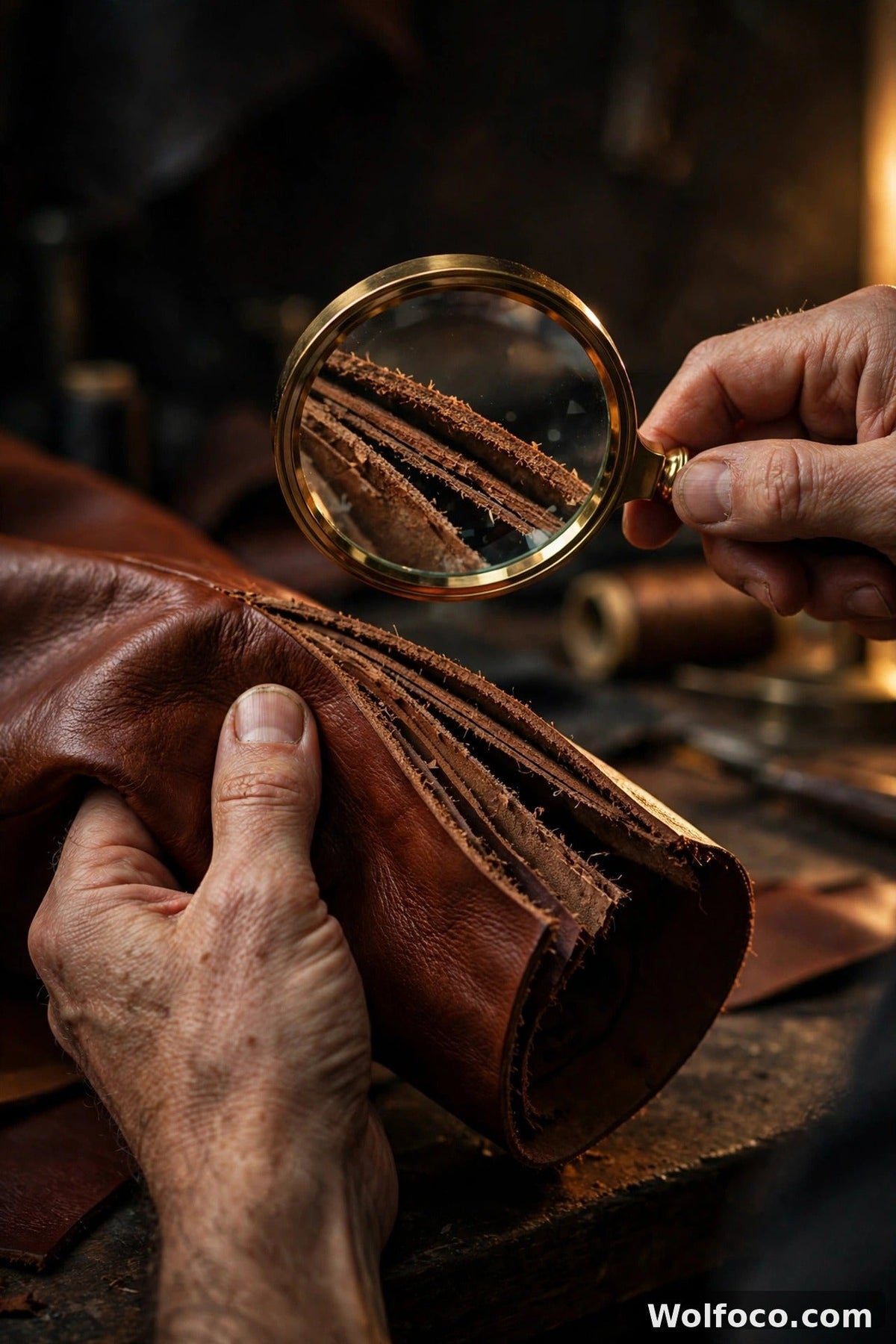
This is the test most fakes fail, because edges are hard to fake. Find an unfinished or semi-finished edge — under the collar, inside a pocket flap, along a seam allowance, or at the hem. Look at the cross-section.
Real leather shows layers that grew together: a smooth grain surface on top, and beneath it a fibrous, suede-like structure — the flesh side of the hide. The edge looks like dense felt or fine wood grain. It may be burnished smooth, but the layers are visibly organic.
Fake leather shows its construction: a thin plastic coating on top, then foam, fabric, or woven backing underneath. The edge looks like a sandwich — coating, padding, cloth — sometimes with little threads pulling away. If you can see woven fabric at the edge, it's not a full hide.

A real hide's edge: grain on top, fibrous flesh side beneath — no fabric, no foam, no layers of glue.
Test 4: The Water-Drop Test
Real leather is porous skin. Put a single drop of water on an inconspicuous spot — under the collar or inside the lower hem — and watch. On genuine leather, the drop slowly absorbs, darkening the spot temporarily before it dries back to normal. The leather drinks it, the way skin absorbs moisture.
On fake leather, the drop just sits there, beading on the plastic coating, refusing to absorb. You could leave it for an hour and it would still be a bead.

Real leather absorbs the drop and darkens briefly; synthetic leather lets it bead on the surface.
Two warnings: do this on a hidden area, because the temporary darkening can startle you. And know that heavily waxed or coated real leather can bead water too — which is why this test is one data point among seven, not the whole case.
Skip the guessing entirely. Every Wolfoco jacket is cut from genuine full-grain hides — the kind that passes all seven of these tests. No plastic, no bonded layers, no surprises when the box arrives.
Test 5: The Label Test
Now read the label — but read it like a skeptic. The single most abused phrase in the industry is "genuine leather." It sounds premium. Legally, it just means "contains some real leather" — and it's actually the lowest grade of real leather, made from the leftover layers of the hide, heavily processed and coated. A jacket labeled only "genuine leather" is telling you the minimum, not the maximum.
What you want to see is specificity: full-grain or top-grain, plus the animal — cowhide, lambskin, goatskin. Specifics are expensive to lie about. Vague terms are cheap: "man-made leather," "vegan leather," "leatherette," and "PU" all mean synthetic. "Bonded leather" means leather dust glued onto fabric — it will peel within a year or two.

Your inspection kit: good light, a magnifying glass, a drop of water, and a healthy suspicion of vague labels.
Red flags on the label: no mention of leather type at all, a label that only says "100% leather" with no grade, or care instructions that read like plastic care ("wipe with damp cloth only" on a jacket that claims to be full-grain). If you want the full breakdown of what each grade actually means, our guide to full-grain vs top-grain vs genuine leather walks through the whole ladder.
Test 6: The Price-Logic Test
A real full-grain leather jacket starts with a real animal hide, which costs real money before anyone has cut, stitched, or finished a single panel — plus skilled labor, hardware, and lining. That is simply what the materials cost. So when you see a "genuine leather jacket" for the price of a pizza dinner, the math doesn't work. Something in that jacket isn't leather.
But here's the part most guides get wrong: price alone proves nothing. Expensive fakes exist — plenty of overpriced "premium" jackets are bonded leather or coated splits dressed up in good marketing. The price test only works in one direction: a suspiciously cheap price is a red flag, but a high price is not a guarantee. Use it to rule jackets out, never to rule them in.

Hold it to the light, check the edges, run the tests — five minutes of inspection beats a lifetime of regret.
Test 7: The Burn Test — Read This Before You Even Think About It
You've probably heard about the burn test: real leather singes and smells like burnt hair (it's protein, like your own hair), while synthetics melt into hard little beads and smell like burning plastic. That's true. Do not do it anyway.
Setting fire to a jacket you own — or one you're considering buying — will damage it, and on a finished jacket the coatings and dyes make the results unreliable anyway. This test belongs in the tannery, on a loose fiber from a hidden seam, performed by someone who knows what they're doing. For a buyer, tests 1 through 6 will catch everything the burn test would, without the fire department.
What NOT to Trust
A label alone. "Genuine leather" is a grade, not a promise — and labels can be printed on anything. The label is a clue; the leather itself is the evidence.
A price tag alone. Cheap means suspicious. Expensive means nothing by itself. Judge the material, not the number.
Perfect looks. The most convincing fakes are the ones that look flawless in photos. Real leather has character — pores, creases, slight color variation. Perfection is the tell.
The word "vegan." Vegan leather is plastic — polyurethane or PVC. That's a legitimate choice if you want to avoid animal products, but it shouldn't be priced or marketed as if it were a hide. Honest sellers say what it is.
A slick website. Beautiful product photography costs a few hundred dollars. A tannery costs millions. Judge workshops by what they show you: named leather grades, close-up edge photos, real workshop imagery, and a returns policy that suggests they're not afraid of you inspecting the goods.
Frequently asked questions
Is genuine leather real leather?
Yes — but it's the lowest grade of real leather, made from the bottom layers of the hide and heavily coated to look uniform. It won't age like full-grain or top-grain, and it wears out faster. When a jacket just says "genuine leather" with no grade specified, treat that as the floor of quality, not the ceiling. Our leather grades guide explains the full ladder.
Can you tell a fake leather jacket just by looking at it?
Often, yes. Uniform, repeating grain patterns, a plastic-like sheen, and edges that look like layered sandwich construction are all visible giveaways. But good fakes can fool the eye in photos, which is why the hands-on tests — smell, pores, edges, water — matter. Never buy an expensive jacket on looks alone.
Does real leather peel?
Real full-grain and top-grain leather doesn't peel like plastic. Peeling and flaking are the signature failure of bonded leather or PU "vegan" leather, where the coating separates from its backing. If your "leather" jacket is peeling in sheets, it was never a full hide.
Why does my leather jacket smell like chemicals?
A chemical or plastic smell usually means the jacket is synthetic, or it's real leather with a heavy synthetic finish. Air it outdoors (never in direct sun) for a few days — a mild factory smell fades, but a true plastic smell won't. If it still smells like a shower curtain after a week, it's telling you what it's made of.
How can I be sure I'm buying real leather online?
Buy from makers who name the exact grade and hide (full-grain cowhide, top-grain lambskin — not just "genuine leather"), show close-up photos of edges and grain, and back it with a real returns policy. Better yet, skip the gamble: a made-to-measure jacket from a real workshop is cut from hides you can ask about by name.
Knowing your hides also helps you spot fakes faster — our cowhide vs lambskin guide shows what each real leather actually looks and feels like, which makes the impostors obvious by comparison.
Once you've found the real thing, it's worth protecting: the Women's Cognac Brown Moto Jacket and the Men's Teal Cafe Racer are both cut from genuine full-grain hides — run all seven tests when yours arrives. We insist.
Done guessing. Real full-grain leather, named hides, honest grades — that's the whole Wolfoco promise. Shop the leather jacket collection →

