
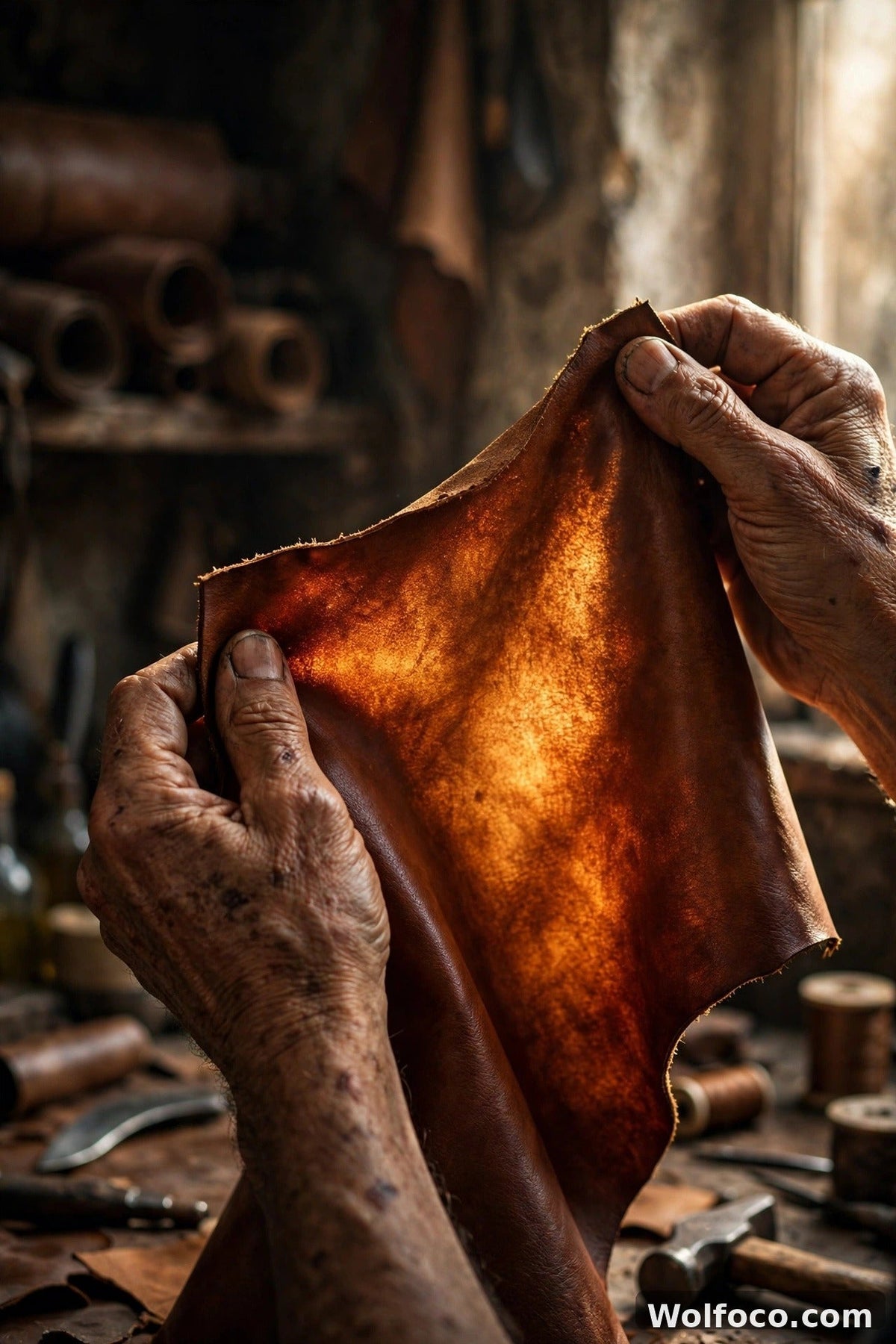

Quick answer: Yes — "genuine leather" is real leather, but the phrase is one of the most misleading in fashion. It is a legal grade name, not a quality promise. On the leather ladder it sits below full-grain and top-grain: genuine leather is usually made from the lower layers of the hide, sanded smooth and coated. Real, yes. Premium, no.
Walk into any store, pick up a jacket, and check the tag. If it says "genuine leather," most shoppers read that as a stamp of quality — of course it's genuine, that's the good stuff. That's exactly what the wording wants you to think. And that's the trap.
The word "genuine" here doesn't mean "the real, best version." It means "this product contains actual animal hide somewhere in it." That is the entire legal bar. A jacket can be labeled genuine leather and still be made from the thinnest, weakest layers of the hide — the parts left over after the good stuff was cut away. Once you understand the grading ladder, you'll never read a leather label the same way again.
Why "genuine leather" sounds better than it is
The confusion is deliberate, and it's old. Decades ago, when synthetic materials started flooding the market, leather sellers needed a word that separated real hide from plastic. "Genuine leather" was that word — it meant not fake. It was never meant to mean top quality.
Over time, the industry quietly built a grading system underneath that word. Full-grain and top-grain became the premium tiers, and "genuine" slid down to become the name of the third tier — while keeping all of its original trustworthy-sounding marketing power. The result: the lowest grade of real leather carries the most reassuring-sounding name.

Every hide gets graded before a single jacket is cut — where your jacket's leather falls on that grading scale decides how it ages.
Think of it like olive oil. "Extra virgin" tells you something specific about how it was made. But if a bottle just said "genuine olive oil," you'd rightly wonder what was being hidden. Leather works the same way. The grades that have something to brag about — full-grain, top-grain — say so loudly. When a label says only "genuine leather," it's telling you the minimum the law requires.
The leather grade ladder, top to bottom
Here's the full ladder, from the best money can buy to outright plastic. Once you can picture it, every label you ever read becomes transparent.

Top to bottom: full-grain, top-grain, genuine, bonded, synthetic. The drop in quality between each step is bigger than most shoppers realize.
1. Full-grain. The top layer of the hide, untouched — the grain you see is the grain the animal grew. It's the strongest, develops the richest patina, and lasts decades. This is heirloom leather.
2. Top-grain. The top layer, lightly sanded to remove imperfections, then finished. Slightly less character than full-grain, but smooth, strong, and the standard for quality jackets and bags.
3. Genuine leather. The lower layers of the hide (the "splits"), heavily processed, sanded, embossed with an artificial grain pattern, and coated. Real leather — but the weakest real leather. It looks fine on day one and ages poorly.
4. Bonded leather. Leather dust and scraps glued onto a fabric backing — technically contains leather, practically falls apart. The stuff that peels.
5. PU / "vegan leather." Plastic. Not leather at all, despite the friendly names.
The jump that matters most for your wallet is between #2 and #3. Top-grain and genuine leather can look nearly identical in a store — but one breaks in beautifully and the other breaks down.
What the label really means: a decoder
Labels are a language, and most of them are written to be misread. Here's how to translate the common ones:

Get close to the label before you get close to your wallet — thirty seconds of reading can save you hundreds.
- "Genuine leather" — Real leather, third tier. The legal minimum claim. Assume the lower splits unless the seller specifies otherwise.
- "Real leather" — Means exactly as much as "genuine." Same tier, friendlier wording.
- "Top-grain leather" / "Full-grain leather" — Specific, verifiable claims. Sellers who use these words are usually proud of the material. Good sign.
- "Split leather" — Honest name for the lower layers. Often what "genuine leather" actually is.
- "Bonded leather" / "Reconstituted leather" — Leather scraps glued together. Avoid for anything you want to keep.
- "Man-made materials" / "All man-made" — Plastic. Sometimes hiding behind "vegan leather."
- No material listed at all — The biggest red flag. A seller proud of their leather names it.
One more trick to know: some labels say "genuine leather" for the shell but use bonded leather for trim, pockets, or lining. The label only has to describe the main material. Flip the jacket inside out and check the rest.
How to tell the grades apart in a store
Labels lie by omission; your hands don't. Sixty seconds of inspection tells you what the tag won't:

Real grain is irregular — pores, creases, tiny imperfections. A perfectly uniform pattern is usually embossed, not grown.
Look at the pores. Real, high-grade leather has irregular, slightly uneven pores — no two square inches match. If the grain pattern repeats perfectly like wallpaper, it's been embossed onto a lower-grade split.
Check the edges. Cut edges of good leather show dense, fibrous layers. Coated genuine leather often shows a plasticky film peeling away from a fuzzy backing at seams and edges.
Press it. Press your thumb in hard. Quality leather wrinkles like skin and the creases fade. Heavily coated low-grade leather resists, then cracks — the coating doesn't flex the way real grain does.
Smell it. Real leather smells rich and organic. Heavy chemical or plastic smells mean heavy coating, which usually means lower-grade hide underneath.
Check the price logic. A "genuine leather" jacket at a full-grain price is the oldest trick in the book. If the price seems too good for the claimed quality, trust the price — it's telling you the grade.
What this means for jackets specifically
Grade matters more in a jacket than in almost any other leather product. A wallet sits in your pocket. A jacket flexes at the elbows and shoulders thousands of times, takes rain, sun, and abrasion. The lower the grade, the faster that flexing turns into cracking — especially along stress points.

A jacket made from good hides only looks better with wear — cheap grades just look worn.
This is also why "genuine leather" jackets dominate the bargain end of the market: they're cheap to produce, photograph well, and feel fine for the first season. The disappointment arrives in year two, when the coating starts to flake at the elbows and the jacket can't be conditioned back to life — because there's no real grain left to condition.
If you're shopping for a jacket you'll actually keep, read our full breakdown of full-grain vs top-grain vs genuine leather before you buy — it goes deeper into how each grade behaves over years of wear. And if you're choosing between hides, our cowhide vs lambskin guide covers which animal the leather came from, which is the other half of the quality question. You can also zoom in on the grain and edges yourself on product pages — for example, the Men's Vintage Brown Genuine Leather Cafe Racer Jacket or the classic Men's Black Genuine Leather Cafe Racer Jacket — and run the touch tests above the moment yours arrives.
Done decoding labels? Wear the real thing.
Every Wolfoco jacket is cut from real leather hides — no bonded scraps, no plastic pretending. Shop leather jackets →
What NOT to do when a label confuses you
- Don't assume "genuine" means "best." It's the third tier wearing a first-tier name. Always ask which genuine.
- Don't pay full-grain money for a genuine-leather label. If the seller can't name the grade beyond "genuine," the price should reflect that.
- Don't confuse "genuine leather" with "bonded leather." Bonded is a step below genuine and peels; genuine is real hide throughout. Different problems, different lifespans.
- Don't trust the front of the tag alone. Check trim, pockets, and lining — the label describes the main material, not every panel.
- Don't skip the touch test. In a physical store, your fingers are a better grading tool than the label. Online, demand close-up photos of the grain and edges.
Frequently asked questions
Is genuine leather real leather?
Yes. Genuine leather is made from real animal hide — usually the lower layers, processed and coated. The confusion comes from the name: "genuine" is a grade designation, not a quality award. It's real leather, but it's the lowest tier of real leather, sitting below full-grain and top-grain.
Is genuine leather good quality?
It's honest but modest. Genuine leather is real, and it beats bonded leather and synthetics — but it won't age like top-grain or full-grain. Expect a good-looking first year or two, then surface cracking at stress points that conditioning can't fix. For a jacket you want to keep for a decade, it's worth stepping up a grade.
What is better than genuine leather?
Two grades: top-grain (the sanded, finished top layer — the standard for quality jackets) and full-grain (the untouched top layer — the strongest and longest-lasting). Both develop patina and survive decades of wear that genuine leather can't.
Does genuine leather peel?
True peeling — flakes lifting off a fabric backing — is a bonded-leather problem, not a genuine-leather one. But heavily coated genuine leather can crack and flake at the surface, which looks similar. If your "leather" jacket is shedding flakes, check whether it was actually bonded leather mislabeled in your mind as genuine.
How can you tell if leather is genuine or fake?
Start with the label using the decoder above, then use your senses: irregular pores, fibrous cut edges, a rich organic smell, and creases that fade when pressed all signal real hide. Uniform repeating grain, plastic smell, and edges that show film over fuzz point to low-grade or fake material.
Why is it called "genuine leather" if it's low quality?
History. The term was coined to distinguish real hide from early synthetics — "genuine" meant "not fake." The grading tiers (full-grain, top-grain) came later, and "genuine" slid down to name the third tier while keeping its trustworthy sound. The name is a relic; the grade is what matters.
Bottom line: "genuine leather" answers one question — is it real? — and dodges the question that actually matters: how good is it? Now you know how to ask the second one. When you're ready to buy from a maker that answers it upfront, browse the Wolfoco leather jacket collection — real hides, honestly described.

