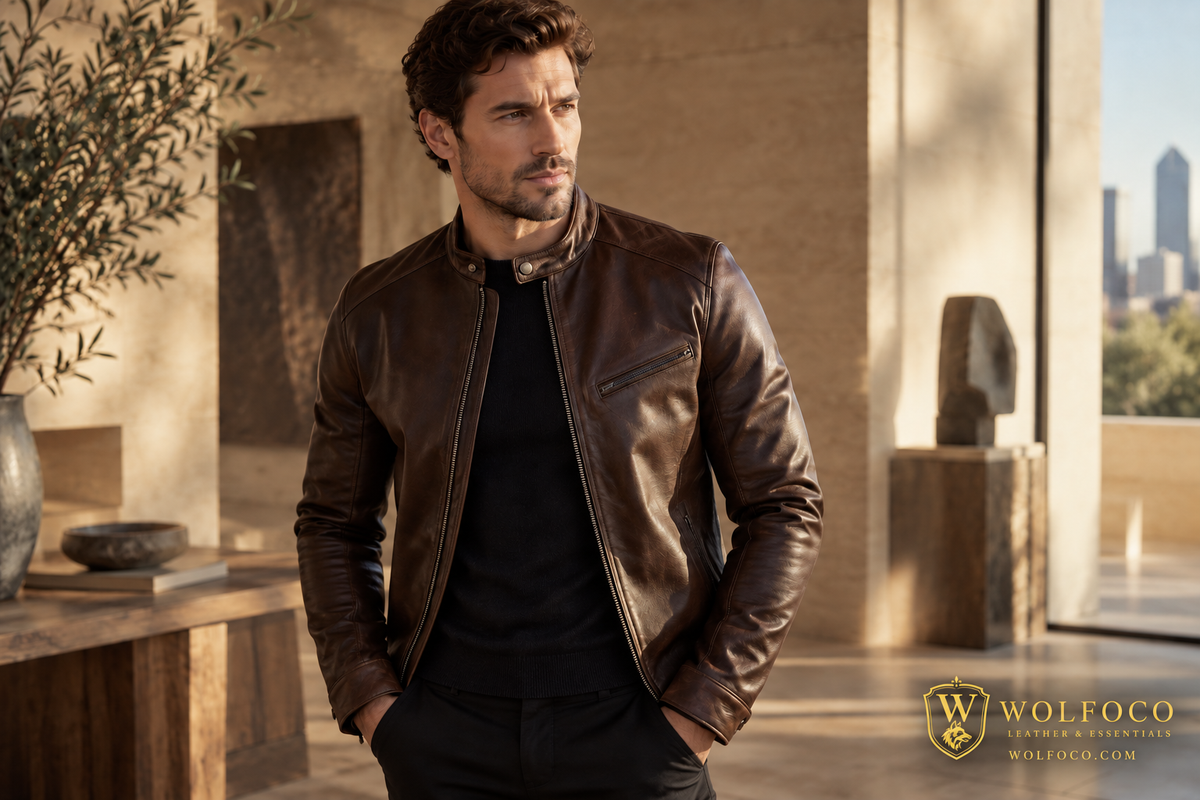
Quick answer: A leather jacket should sit cleanly at the shoulder edge, close comfortably over your usual base layer, end near the wrist bone, and allow you to reach forward without severe pulling across the back. It should feel shaped rather than restrictive. Compare your body measurements with the finished garment measurements; the letter on the size label is not enough.

Leather jacket fit at a glance
The right fit depends on the silhouette, leather, lining and how you plan to wear the jacket. A slim cafe racer is expected to sit closer than a bomber. A motorcycle-inspired jacket can feel structured without limiting normal movement. A jacket intended for winter layering needs more ease than one worn over a T-shirt. These differences matter more than choosing a familiar size automatically.
| Area | Good fit | Warning sign |
|---|---|---|
| Shoulders | Seam finishes at the natural shoulder edge | Seam hangs down the arm or cuts inward |
| Chest | Closes without strong X-shaped pulling | Zipper strains or front billows |
| Sleeves | Cuff reaches around the wrist bone | Hands disappear or wrist is exposed at rest |
| Back | Clean shape with enough reach | Deep horizontal tension lines |
| Waist | Follows the intended silhouette | Rides upward or collapses in excess folds |
| Movement | You can drive, sit and reach naturally | Normal motion feels restricted or painful |
How to measure yourself for a leather jacket
Use a flexible cloth tape, stand naturally and wear the kind of layer you expect beneath the jacket. Keep the tape level and comfortably close rather than pulling it tight. If possible, ask another person to measure you. Repeat every number before ordering a standard or custom leather jacket.
- Chest: Measure around the fullest part of the chest, under the arms and across the shoulder blades.
- Shoulder width: Measure across the back from one shoulder edge to the other, following the natural curve.
- Sleeve length: Start at the shoulder edge and measure over a slightly bent elbow to the wrist bone.
- Back length: Measure from the prominent bone at the base of the neck to the desired hem.
- Waist: Measure where the jacket will close, not necessarily at the narrowest point.
- Upper arm: Measure around the fullest part of the bicep while keeping the arm relaxed.

Body measurements and garment measurements are not interchangeable. A finished jacket needs additional room—often called ease—so you can breathe and move. The appropriate amount varies by design and leather behavior. Ask for the finished chest, shoulder, sleeve and back measurements whenever the product page does not show them. For a custom leather jacket, record both inches and centimeters to reduce transcription mistakes.
How should a leather jacket fit in the shoulders?
The shoulder is the most important starting point because it controls how the sleeves hang and how the upper body moves. On a conventional set-in sleeve, the shoulder seam should meet the point where your shoulder begins to curve downward. A seam far below that point usually means the jacket is oversized unless the design is intentionally dropped-shoulder. A seam sitting inside the shoulder can make the sleeve pull upward and create pressure across the upper back.

Look at the jacket from the front, side and back. Small creases are normal because leather is a natural material. Strong diagonal lines from the neck toward the armhole suggest tension. A hollow pocket of fabric above the chest can indicate excess width or an incompatible shoulder slope. Do not assume a thick leather jacket will permanently reshape enough to correct a poor shoulder fit.
How tight should the chest feel?
Zip or button the jacket fully over your normal layer. You should be able to breathe deeply and slide a flat hand inside the chest without forcing it. Mild initial structure is normal; painful pressure, a distorted zipper or pronounced X-shaped wrinkles are not. At the other extreme, a front that hangs away from the body and large folds at the sides can make a tailored jacket look too large.
Leather jacket sleeve length and mobility
For most everyday leather jackets, the sleeve should finish at or just beyond the wrist bone when your arms rest naturally. Motorcycle-oriented sleeves may be slightly longer to maintain coverage when the arms reach forward. The cuff should not swallow the hand or prevent a watch from sitting comfortably.

Perform a simple movement test: reach forward as if holding a steering wheel, raise each arm, bend both elbows, sit down and zip the jacket. Some lift is expected in a close-fitting leather jacket, but the hem should not climb dramatically and the collar should not press into the neck. The lining should move smoothly without twisting. If mobility is poor even when the chest measurement seems adequate, the armhole, upper-arm width or back width may be the real issue.
Where should a leather jacket end?
A classic cafe racer or biker jacket commonly ends near the belt line or upper hip. A leather bomber often finishes at the waist with a ribbed band. A trucker jacket may sit around the upper hip, while a leather blazer or coat is intentionally longer. The best jacket length balances the design with your torso and intended outfit.
Check the length while standing and sitting. A short jacket should not expose an unintended gap whenever you move. A longer jacket should not bunch heavily across the lap. If you plan to wear the jacket with high-rise trousers, dresses or longer knitwear, test those proportions before deciding.
How fit changes by leather jacket style
Cafe racer jacket fit
A cafe racer usually has a clean collar, minimal bulk and a close, streamlined body. It should follow the torso without stretching the zipper. The armholes need enough room for forward reach, particularly if you commute or ride.
Biker or moto jacket fit
A biker jacket can accommodate more hardware, lapels and asymmetry. Judge the fit with the jacket open and closed because the front overlap changes the silhouette. Hardware should lie flat rather than being pulled out of alignment.
Leather bomber jacket fit
A bomber generally allows more room through the body and finishes with a fitted waistband. A little volume is intentional, but the shoulders should remain controlled and the waistband should not ride up continuously.
Cropped leather jacket fit
A cropped jacket should end at its intended visual point without becoming too short during normal reach. Sleeve and shoulder balance are especially important because the abbreviated hem makes proportion errors more visible.
Leather blazer fit
A leather blazer should close smoothly, follow the lapel line and leave room through the upper back. Evaluate it with the blouse, shirt or light knitwear you will actually wear underneath.
Should a leather jacket be tight at first?
A new leather jacket can feel structured and may soften with wear, but “break-in” should never be used to justify incorrect sizing. Leather can relax modestly at areas of repeated movement; shoulder width, sleeve length and overall pattern do not transform reliably. Buy for functional comfort now, not for a hoped-for future shape.
Leather type and thickness influence the initial feel. Softer lambskin can drape sooner than substantial cowhide. Finish, lining and panel construction also affect movement. Because the Wolfoco catalog includes different silhouettes, compare each product’s stated specifications rather than applying one rule to every jacket.
Layering under a leather jacket
Decide whether the jacket will be worn primarily over a T-shirt, a shirt or medium knitwear. Measure and test with that layer. Adding excessive room for a sweater you rarely wear can weaken the everyday silhouette. Conversely, a close summer fit may be uncomfortable in cold weather. If one jacket must cover several seasons, prioritize shoulder mobility and chest ease while keeping the waist intentional.

Seven common leather jacket sizing mistakes
- Choosing only by S, M, L or an old jacket’s label.
- Measuring the body while wearing a bulky layer that will not normally be used.
- Confusing body dimensions with finished garment dimensions.
- Ignoring shoulder position because the chest closes.
- Checking sleeve length only with arms hanging straight.
- Assuming all genuine leather jackets stretch enough to correct a tight fit.
- Approving a custom order before the final measurements and design specification are written clearly.
Shop Wolfoco leather-jacket directions
Use this guide with the measurements shown on the individual product page. Product availability, leather specification and customization must be confirmed for the exact style you select.
- Women’s Black Minimalist Moto Jacket — a clean slim-fit direction.
- Women’s Black Cafe Racer Jacket — a streamlined motorcycle-inspired silhouette.
- Women’s Cognac Moto Jacket — a warm brown fitted option.
- Men’s Black and Brown Leather Jacket — a more expressive layered design.
Shop men’s leather jackets Shop women’s leather jackets Request a custom-fit review
Related Wolfoco guides
- Full-grain vs top-grain vs genuine leather
- How to clean and condition a leather jacket
- Cafe racer, bomber or biker jacket?
- Women’s leather-jacket style and fit guide
- Custom leather-jacket ordering guide
Frequently asked questions
How do I know whether my leather jacket is too small?
Strong zipper strain, painful chest pressure, shoulders pulling inward, limited reach and deep tension lines across the back are common signs. Test the jacket over your normal layer while sitting and reaching forward.
How do I know whether it is too large?
Shoulder seams hanging far down the arm, excessive folds at the sides, sleeves covering the hands and a collar that floats away from the neck can indicate excess size, unless the design is intentionally oversized.
Should I size up in a leather jacket?
Not automatically. Compare your measurements with the specific garment measurements and account for the layer you plan to wear. Different brands and silhouettes use different grading.
Can a tailor alter a leather jacket?
Some alterations are possible, but leather requires specialist equipment and skill. Sleeve shortening or body shaping may affect zippers, cuffs, lining and seam marks. Confirm feasibility and cost before buying an incorrect size.
Where should the shoulder seam sit?
On a traditional set-in sleeve, it should align close to the natural shoulder edge. Dropped-shoulder and intentionally oversized designs are exceptions.
Where should leather jacket sleeves end?
Most everyday styles finish around the wrist bone. Riding-oriented sleeves may be slightly longer to preserve coverage when reaching forward.
How much room should be in the chest?
The jacket should close without severe pulling and allow normal breathing and movement. The exact ease depends on style, leather and intended layering.
Will a leather jacket stretch?
Leather may soften and relax modestly in areas of movement, but it will not reliably correct poor shoulder width, sleeve length or pattern balance.
Editorial note: This guide provides general fit education. Exact product specifications and customization options should be confirmed on the individual Wolfoco product page or in writing before production.