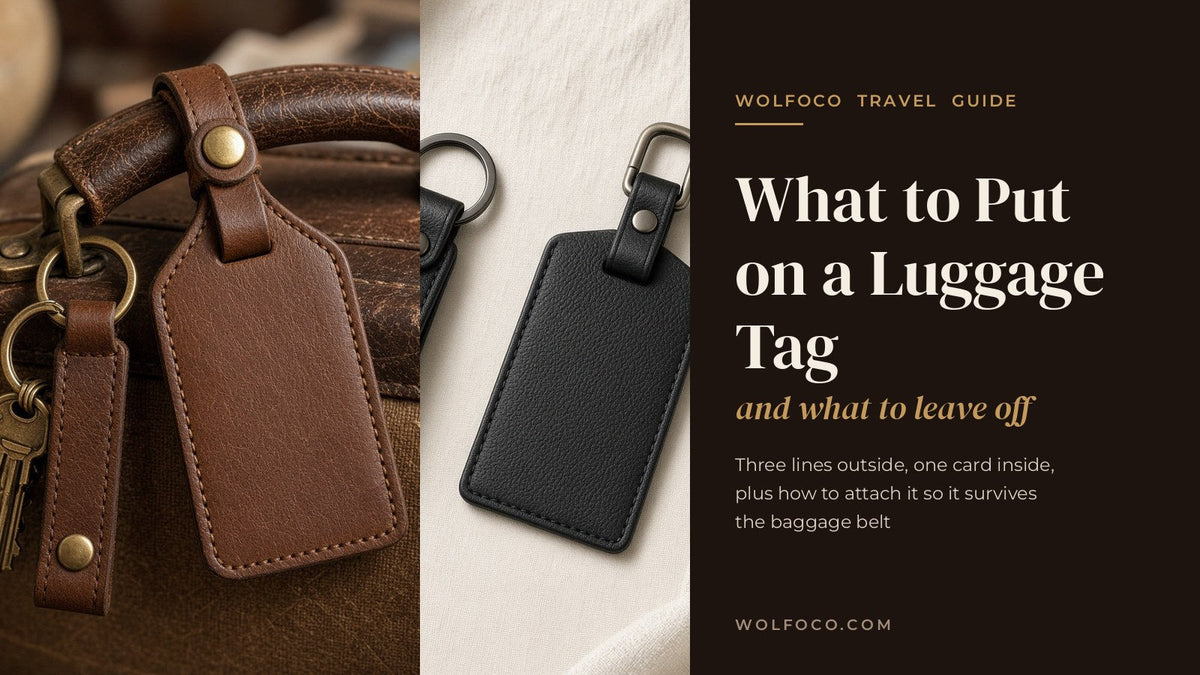
The short answer: put three things on the outside of your luggage tag — your name (or first initial and last name), a mobile number with the country code (+1 for the US), and an email you actually check while you're away. Leave your home address, travel dates and flight numbers off the outside. Then put the same contact details, plus where you're staying, on a card inside the bag. That's it. A clean, readable tag beats a crowded one every time.
That's also roughly what the U.S. Department of Transportation says. Its current baggage guidance tells travelers to make sure checked bags are labeled with a name, phone number and email address, because almost all delayed bags turn up eventually and labels are how the airline reaches you. The rest of this guide is the practical part: exactly how to lay the lines out, what to leave off and why, how to attach a tag so it survives a baggage belt, and what to do if you're flying international this holiday season.
We're a small leather shop in Prosper, Texas, just north of Dallas, so DFW and Love Field are our home airports. If you've ever stood at a carousel the Sunday after Thanksgiving watching a long line of identical black roller bags go by, you already know why a tag matters.

What to put on a luggage tag: the three lines that matter
Think about who reads your tag. It's an airline baggage agent holding a bag that didn't make its connection, or a stranger who grabbed the wrong suitcase at baggage claim and wants to fix it. Neither of them needs your life story. They need to know whose bag it is and how to reach that person today.
Line 1: Your name
Use the name on your ticket. When an airline traces a bag, it matches the bag to the passenger record, so "Bobby" on the tag and "Robert" on the booking just slows things down. If you'd rather keep a low profile on the outside, a first initial plus your full last name works fine. That's enough for a match without broadcasting your full name to everyone in the security line.
Line 2: A mobile number with the country code
This is the most important line on the tag. Write it as +1 214 555 0100, not (214) 555-0100. The plus sign and country code mean the number works no matter where the bag ends up. A bag that was supposed to go DFW to London and lands in Dublin instead is going to be handled by someone who doesn't dial US numbers every day.
Use your cell, not a home landline. Your landline rings in an empty house while you're standing in a hotel lobby in another time zone.
Line 3: An email address
Phones die, roaming gets switched off, and voicemail fills up. Email is the backup channel the airline can use from any desk. If you don't want your main inbox on a public tag, set up a simple travel address and forward it to your phone. Just make sure it's one you'll actually look at.
Optional fourth line: a short "If found, please call" or "Reward if found." It doesn't change anything legally, but it nudges a stranger toward picking up the phone.
What to leave off the outside of your tag
Here's the part most people get wrong. The outside of a luggage tag is public. It sits at the curb, on the belt, on the cart, on the carousel, and in the overhead bin next to strangers. So anything on it should be safe for anybody to read.
- Your home address. A tag that says where you live, hanging off a suitcase that says you're not there, is a bad combination. Older advice (including archived government tips) used to recommend a home address on the outside. Most travelers today keep it inside the bag or skip it.
- Travel dates and flight numbers. Same problem. They tell a reader how long the house will be empty.
- Passport, driver's license or Social Security numbers. Never. There is no luggage situation where an airline needs these written on your bag.
- Your employer and job title. It's more information than anyone needs, and on a business trip it can tell a stranger more than you'd like.
- Too many lines. Crowded tags get skimmed. Three clear lines in big, dark lettering beat eight lines of small handwriting.

The inside card: the step nobody skips twice
Outside tags get torn off. Straps catch on belt rollers, cheap plastic snaps crack in a cold cargo hold, and sometimes the tag is just gone when the bag comes around. That's why DOT has long recommended labeling bags inside and out.
Your inside card can carry more detail because it's private:
- Your name, mobile number with country code, and email (same as outside)
- Where you're staying on this trip: hotel name, address and phone, or the address of the family you're visiting
- Your home or work address, if you want it somewhere
- A second contact, like a spouse or a friend at home
Put it right on top of your clothes, or tape it to the inside lid, so it's the first thing anyone sees when they open the bag. A dopp kit pocket is another good spot for a second card, since a toiletry bag often moves from suitcase to suitcase. A business card works if you add a handwritten line on the back with where you're staying.
Two more minutes of prep that pay off if a bag goes missing: take a photo of your bag (outside and open, so you can show the contents), and write down the brand and color. Describing "a black roller bag" to an airline is nearly useless. "A 22-inch black Samsonite with a brown leather tag on the top handle" gets found.
How to attach a luggage tag so it stays on
Where and how you attach the tag matters almost as much as what's written on it.
- Use the top carry handle, not the telescoping handle. The pull-up handle retracts into the bag and can pinch or shear a strap. The fixed top handle is the standard spot, and it's where agents look first.
- Loop it snug. A tag that hangs on a long, loose strap swings into belt rollers and gets caught. Wrap the strap close around the handle and fasten it so the tag sits right against the bag. DOT's own advice is to remove loose straps and hooks from garment bags before you check them for the same reason: anything that dangles can catch in baggage machinery.
- Check the fastener. Snap, buckle, screw post or loop strap, give it a hard tug before you leave the house. A worn snap is the most common reason a tag disappears.
- Add a second tag on a side handle if you check two bags that look alike. It makes your bags easier to spot as a pair.
- Peel off old airline stickers and routing tags. Old barcodes can confuse automated sorting and send a bag the wrong way. Airport travel tips say the same thing: remove old destination tags before every trip.
On our own Marker leather luggage tag, the leather strap wraps around the handle and snaps closed, so the tag sits close to the bag instead of swinging on a long cord. Whatever tag you use, that's the goal: tight to the handle, easy to read, hard to rip off.

What to put on a luggage tag for international travel
"What to put on a luggage tag international" is one of the most common versions of this question, and the answer is mostly the same with a few tweaks:
- Country code is not optional. +1 for the US and Canada. If you live abroad, use your own country code.
- Write your name as it appears on your passport. International bag tracing runs through airline systems that match passport names.
- Put your destination address on the inside card, including the country. If a bag is delayed, the airline will usually deliver it to where you're staying, and that's the address they'll need.
- Use Latin letters and big numbers. Someone handling your bag may not read English well, but almost everyone in an airport can read a phone number.
- Skip the "U.S." phone formatting. Parentheses and dashes are a US habit. Spaces are universal.
If you're flying out of DFW on a long-haul trip with a connection in Europe or Asia, that connection is where bags go astray most often. DOT notes that the odds of a baggage problem go up as you move from a nonstop flight, to a direct flight with a stop, to a connection on the same airline, to a connection between two airlines. A good tag doesn't stop a misconnect, but it shortens the time it takes to get the bag back.
Printed tag, paper airline tag or leather tag?
Airlines hand out free paper tags at the counter, and they work in a pinch. But paper tears, ink smears in the rain on the ramp, and the string snaps. Hard plastic tags are durable, but they can crack and their windows can scratch or fog. Leather tags are what most frequent travelers end up with, for three practical reasons:
- They flex instead of cracking. Leather bends when a bag gets shoved into a full cargo hold.
- They're easy to spot. A brown or black leather tag on a black roller bag is a quick visual check at the carousel.
- They age well. A good leather tag gets better looking with a few trips instead of worn out.
The trade-off is that leather tags vary a lot. Some have an ID window, some have a card slot on the back, and some are a solid leather panel meant for a monogram. If your tag doesn't have a place to write contact details, put initials on the outside for recognition and rely on a contact card inside the bag. That's a perfectly good setup, and it keeps your phone number private.
Choose this if… (a quick guide to tag setups)
Choose a name-and-number tag if you check a bag a few times a year and want the simplest setup. Three lines outside, one card inside.
Choose a monogram or initials tag if you care more about spotting your bag fast and keeping your details private. Put your full contact information inside the bag, and keep the outside to initials.
Choose two tags if you're flying international with a connection, or checking bags that look like everyone else's. One on the top handle, one on a side handle.
Choose a smart tracker plus a tag if you travel a lot for work. A tracker tells you where the bag is; the tag tells the airline whose it is. They do different jobs, so use both.
Choose a matching leather keychain and luggage tag set if you're shopping for a gift. It's the kind of thing people rarely buy for themselves but use on every trip. Our Marker set is $29 in Black or Brown and includes one keychain and one luggage tag.
What to write on a luggage tag: copy-and-paste layouts
Here are three layouts we'd actually use. Swap in your own details.
Everyday domestic tag
J. Ramirez
+1 469 555 0142
jramirez.travel@email.com
Privacy-first tag
JR
+1 469 555 0142
If found, please call. Thank you.
International trip tag
JOSE RAMIREZ (as on passport)
+1 469 555 0142
jramirez.travel@email.com
Inside card for the same trip
Jose Ramirez · +1 469 555 0142 · jramirez.travel@email.com
Staying at: [hotel name, street address, city, country, hotel phone]
Home contact: [spouse or friend's name and number]
(The numbers and emails above are made-up examples. Please don't call them.)

Holiday travel from Dallas: a few local notes
North Texas has two big airports, and both get packed around Thanksgiving and Christmas. DFW is American Airlines' largest hub, which means a lot of connecting traffic and a lot of bags moving between flights. Love Field is Southwest's home base, with mostly point-to-point flights. If you have a choice, a nonstop from either one is the safest bet for your bag.
A few things worth knowing before you head to the airport:
- Black roller bags are everywhere. At peak times the carousel is a sea of them. A brown leather tag, a colored strap, or both will save you from grabbing someone else's bag, which is easy to do at a crowded carousel.
- Curbside check-in is fast, but check your tag before you hand it over. Once a bag is on the belt, you can't fix a loose snap.
- Texas weather can turn on you. Bags sit on the ramp in the rain before loading. Paper tags and ink do badly in a December downpour; leather and printed cards hold up.
- Flying home with gifts? If you're bringing back wrapped presents in a checked bag, your inside card matters even more. A bag that gets opened for TSA screening may be rearranged, and you want the card to be easy to find.
Why a leather luggage tag makes a good gift
We'll be honest about our bias here. We sell a leather keychain and luggage tag set. But there's a reason it's one of the easiest gifts in our shop to recommend.
It's useful for almost anyone who travels, it's small enough to ship or stuff in a stocking, and it's personal without being risky. You don't need to know someone's size, style or wallet habits. If they fly once a year to see family or every week for work, they'll use it.
The Marker set pairs a leather keychain with a matching leather luggage tag in Black or Brown for $29. It works well on its own, as a groomsmen gift where everyone gets the same color, or as an add-on with a bigger travel gift. If you'd like initials on it, contact us before you order and we'll tell you what's possible for that piece. Personalized items are made for you, so they take 5–14 business days and are final sale unless something is wrong on our end.
If you want to build a small travel set, these three go together:
- The Marker — Leather Keychain & Luggage Tag Set, $29
- The Slimfold — RFID Leather Wallet / Money Clip, $59, for a front-pocket carry through the airport (here's how to use a money clip wallet without it getting fat)
- The Traveler — Personalized Leather Dopp Kit, $79, in Black, Brown or Cognac
For more ideas, see our Christmas leather gifts under $100, the leather gifts for men in Dallas guide, or the full wallets and personalized gifts collection. Leather is also the traditional third-anniversary material, so a travel set fits our third anniversary leather gifts list too.

How to care for a leather luggage tag
A leather tag lives a rough life: belts, rain, cargo holds, overhead bins. A little care keeps it looking good for years.
- Wipe it after a wet trip. Pat it dry with a soft cloth and let it air-dry at room temperature. Don't put it on a heater.
- Condition it a couple of times a year. A small amount of leather conditioner keeps the strap flexible, which matters most at the fold where it wraps the handle.
- Check the snap or buckle before each trip. Hardware is what fails first on any tag.
- Treat scuffs gently. Most light scuffs buff out with a fingertip and a little conditioner. Our guide to fixing leather scratches, scuffs and water spots covers the rest.
Shipping, returns and warranty
We ship from Prosper, Texas. Ready-to-ship US orders typically arrive in 3–7 business days, and custom orders typically take 5–14 business days. We also ship internationally, including to Canada, the UK, the EU, Australia and New Zealand. International orders ship DAP, so import duties and taxes are paid by the customer, and live rates show at checkout. Full details are on our Shipping Information page.
Non-personalized items come with a 30-day 100% refund, and every piece is covered by our craftsmanship warranty. If stitching, edges or hardware fail because of how we made it, we'll repair or replace it. See our Refund and Returns Policy.
Frequently asked questions
What should I put on my luggage tag?
Your name (or first initial and last name), a mobile number with the country code, and an email you check while traveling. Put the same details plus where you're staying on a card inside the bag.
Should I put my home address on a luggage tag?
Most travelers now leave it off the outside. A visible home address on a bag that's clearly traveling tells strangers where an empty house is. If you want an address somewhere, put it on the inside card or use a work address.
What should you not put on a luggage tag?
Your home address on the outside, travel dates, flight numbers, passport or ID numbers, and anything else you wouldn't want a stranger to read. Keep the outside to name, phone and email.
What does the Department of Transportation recommend for luggage labels?
DOT's current baggage guidance says to make sure checked bags are labeled with your name, phone number and email address. Its older guidance also recommended labeling bags inside and out.
What do I put on a luggage tag for international travel?
Your name as it appears on your passport, a mobile number with the country code (+1 for the US), and an email. Put your destination address, including the country, on the inside card.
Where do you attach a luggage tag?
On the fixed top carry handle, wrapped snug so the tag sits close to the bag. Avoid the telescoping pull handle, which retracts into the bag and can pinch the strap.
Do I need a luggage tag on a carry-on?
It's a good idea. Carry-ons get gate-checked on full flights all the time, especially around the holidays, and a gate-checked bag without a tag is just another black roller.
Is a luggage tag still useful if I have a tracker in my bag?
Yes. A tracker tells you where your bag is. A tag tells the airline or a stranger whose bag it is and how to reach you. They solve different problems.
Is a leather keychain and luggage tag set a good gift?
For most people who travel, yes. It's useful, easy to ship, doesn't depend on size or style, and gets used on every trip. The Marker set is $29 and comes in Black or Brown.
Can I get initials on The Marker?
Contact us before you order and we'll tell you what's possible for that piece. Personalized items take 5–14 business days and are final sale unless they arrive defective or incorrect.
Do you ship leather luggage tags internationally?
Yes. We ship to Canada, the UK, the EU, Australia, New Zealand and more. Orders ship DAP, so duties and taxes are paid by the customer. Live rates show at checkout.
What if I don't like it?
Non-personalized items can be returned unused within 30 days of delivery for a 100% refund of the product price, and our craftsmanship warranty covers defects in how we made the piece.
The bottom line
A luggage tag only has one job: get your bag back to you. Name, mobile number with country code, and email on the outside. Everything else, including where you're staying, on a card inside. Snug it to the top handle, tug the fastener before you leave the house, and take a photo of your bag. Do those four things and you're ahead of most people in the DFW check-in line.
And if you know someone flying home for the holidays, a good leather tag is one of those small gifts that gets used every single trip. Safe travels.