
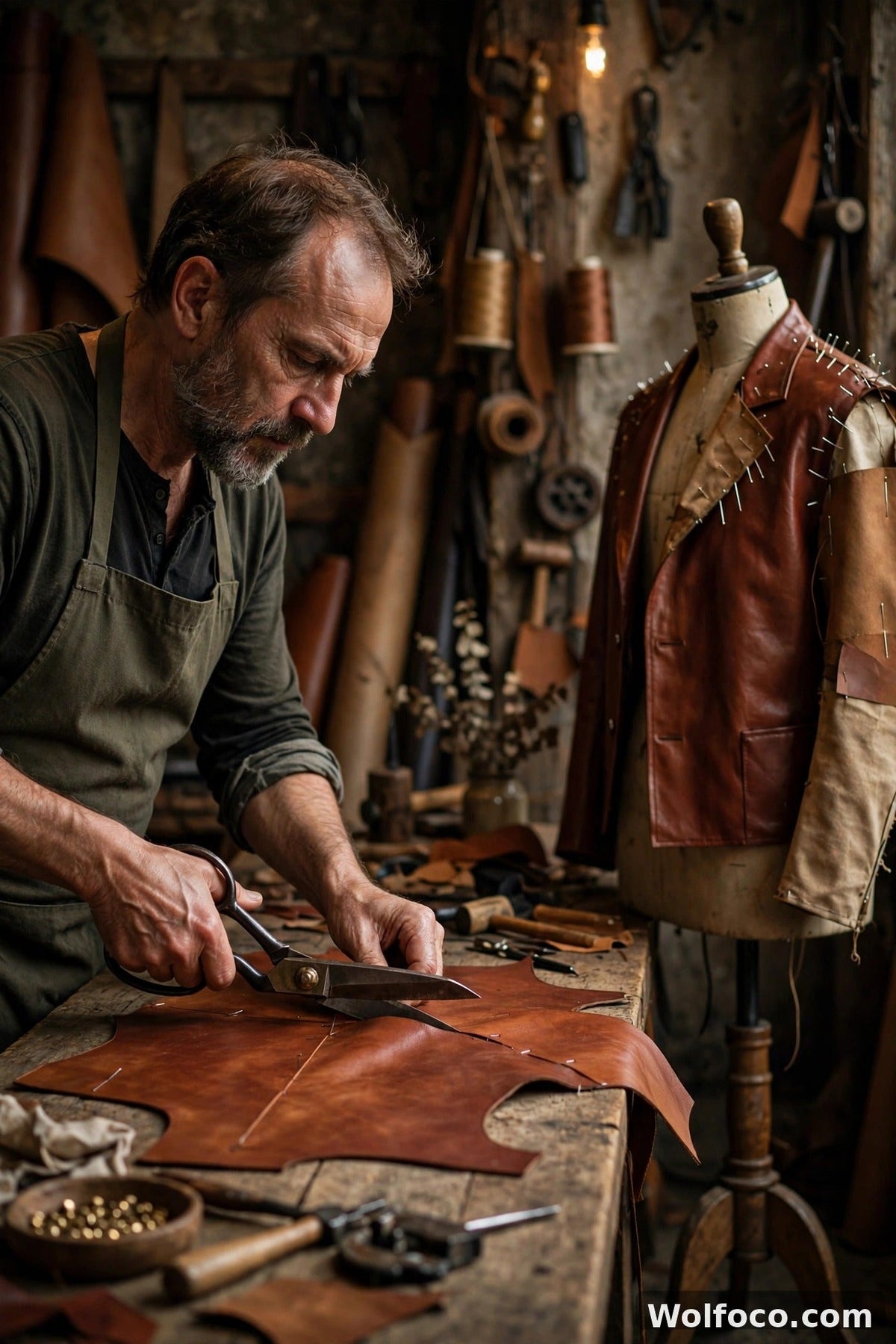

Quick answer: A custom, made-to-measure leather jacket typically costs several times an off-the-rack one, because you're paying for three things: the grade of leather, the hours of skilled labor, and individual pattern work. Full-grain hides, hand-stitching, and heavy customization push the price up. Judge any quote by what's inside it — not the number alone.
Here's the frustrating part about shopping for a custom leather jacket: almost nobody tells you the price up front. You fill out a form, send your measurements, wait for a quote, and hope the number that comes back is fair. Meanwhile, off-the-rack jackets have price tags, and you're left doing mental math with no real information.
This guide does what most sellers won't: it breaks down exactly where the money goes in a custom leather jacket. Not to sell you on a specific number, but so you can read any quote — from any maker — and know instantly whether it's honest, inflated, or suspiciously cheap. Because a price that's too low is usually a bigger warning sign than a price that's high.
Where the Money Actually Goes
A custom leather jacket has three big cost buckets, and they matter in this order: the leather, the labor, and the customization itself.
The leather is usually the single largest cost. A jacket needs roughly 40 to 55 square feet of hide, depending on size and style, and not every square foot of a hide is usable — belly sections, scars, and thin spots get cut away. Higher-grade hides cost more per foot and waste more in cutting, because the maker is being pickier about which panels make the final jacket.
The labor is the part people underestimate most. A made-to-measure jacket isn't pulled from a stack and adjusted — it's cut from an individual pattern, assembled, fitted (sometimes twice), and finished by hand. That's many hours of a skilled craftsperson's time versus minutes on a production line. You're paying for a person, not a process.
The customization — your measurements, your chosen style details, your lining, your hardware — adds pattern-drafting time, extra fittings, and one-off material sourcing. Standard options cost less; anything unusual costs more, because it can't be batched.
The Leather Grade: The Biggest Price Driver
If two custom jackets look identical in photos but one costs twice as much, the leather is almost always the reason. Here's the honest hierarchy, from most to least expensive in a custom build:

Hide grades side by side: what you're really choosing between when a maker quotes you.
Full-grain leather is the top of the market — the outermost layer of the hide, untouched, with all its natural strength and character. It costs the most because it's the rarest cut and the most demanding to work with. It also ages the best, developing the patina that makes a jacket look better at year five than at month one. If you're buying one custom jacket to keep for decades, this is where the money is well spent.
Top-grain leather is sanded and refinished, which makes it more uniform and slightly less expensive. It's still real, durable leather — most quality custom jackets live in this tier. You're trading some character and longevity for consistency and a lower price.
Genuine leather (the confusing label) is technically real leather, but it's made from the lower layers of the hide. It's the cheapest "real leather" a maker can use, and it won't age or last like the grades above. A rock-bottom custom quote almost always means this grade — or worse, bonded leather, which is leather dust glued to fabric and has no business in a "custom" jacket at any price.
When you get a quote, ask one question: what grade of hide, specifically? A maker who answers clearly is usually honest about everything else. A maker who dodges is telling you something too.
Labor and Construction: Hand vs. Machine
The second-biggest driver is how the jacket is actually put together. Machine-stitched seams are fast and consistent; hand saddle-stitching is slow and, done well, stronger — two needles, one thread, each stitch locked by the next. A fully hand-stitched jacket takes dramatically longer to build, and that time shows up in the quote.

Saddle stitching by hand: slow, strong, and the main reason labor dominates a custom quote.
Most good custom jackets are a hybrid — machine work for long structural seams, hand work for stress points, edges, and details. That's the sweet spot for most buyers: you get durability where it matters without paying for handwork where it doesn't show.
Fittings matter too. A true made-to-measure process includes at least one fitting or mock-up stage, where the jacket is tried on before final finishing and adjusted. Each fitting round is more skilled hours. Made-to-order (you pick a size, they build it) skips this and costs less — but it's not really custom, whatever the marketing says.
What Drives the Price Up (and What's Worth It)
Beyond leather and labor, the details stack up. Some are worth every penny; others are where margins hide.
Worth paying for: a heavier, better lining (it changes how the jacket feels and lasts); solid brass or quality zippers and snaps (cheap hardware is the first thing to fail on any jacket); reinforced stress points at the shoulders, elbows, and pocket mouths. These are the invisible things that separate a ten-year jacket from a three-year one.
Costs more, pay if you want it: unusual colors and finishes (custom dye work is skilled labor); intricate paneling or quilting; exotic leathers. These are legitimate upcharges — they take real extra time and materials.
Question hard: vague "premium" or "luxury" surcharges with no specifics attached; rush fees that double the price for a modest speedup; "design consultation" fees from makers who then upsell you at every step. A transparent maker itemizes. A murky one bundles.

Every component has a cost — and a reason. That's what you're really buying.
Want a custom jacket without the quote-runaround?
Wolfoco builds made-to-measure leather jackets from your actual measurements — full-grain hides, honest construction, no mystery pricing games. Start your custom jacket →
What NOT to Overpay For
Now the other side of the coin. Here's where buyers routinely spend money that buys them nothing:
A brand name on the label. In custom work, you're paying for the maker's hands, not their logo. A famous label on a custom jacket adds cost without adding a single stitch of quality. Judge the workshop, not the wordmark.
"Italian leather" as a magic phrase. Italy tans wonderful leather — and also completely ordinary leather. The country of origin is not a grade. Ask for the tannery, the grade, and the thickness. Those three answers tell you everything; the country tells you nothing.
Over-customization. Every extra detail — contrast stitching here, a special pocket there, an unusual collar — adds pattern time and failure points. The most expensive custom jackets are often the ones where the buyer designed by committee. A clean, well-executed classic beats a fussy, over-detailed build at any price.
Rush fees you don't need. Custom takes time because good work takes time. Paying a large premium to shave two weeks off a build that takes two months rarely changes the outcome — it just changes the invoice.
How to Tell If a Quote Is Fair

A real fitting is part of what you're paying for — and part of how you judge the maker.
Forget comparing headline numbers. Two quotes can differ by hundreds and both be fair — or both be wrong. Instead, compare what's inside:
1. Get the spec sheet. A fair quote names the leather grade, thickness, lining, hardware brand or type, stitching method, and number of fittings. If a maker won't put this in writing, walk away — not because the price is wrong, but because you can't know if it's right.
2. Compare like with like. A full-grain, hand-finished, double-fitting jacket will always cost more than a top-grain, machine-built, single-fitting one. That's not overcharging; that's a different product. The scam isn't the high price — it's the high price attached to low specs.
3. Watch the floor, not just the ceiling. A custom, made-to-measure, full-grain leather jacket quoted at fast-fashion prices is not a bargain. It's a lie — about the leather, the labor, or both. The cheapest quote in custom leather is almost never the best value; it's usually the one cutting the corners you can't see in photos.
4. Ask about alterations and guarantees. Reputable custom makers stand behind fit — they'll adjust or remake if the measurements they took don't work out. That guarantee has real value baked into the price, and makers who offer it tend to be the ones who get it right the first time.
If you want to understand the ordering process itself — measurements, timelines, what to expect at each step — our custom leather jacket ordering guide walks through it start to finish. And if you're deciding between hide types, the cowhide vs. lambskin breakdown covers how each leather behaves in a jacket you'll actually wear. For getting measurements right the first time, see how to measure for a leather jacket.
Frequently asked questions

The finished product: this is what the leather, the labor, and the fittings are all building toward.
How much does a custom leather jacket cost?
There's no single number — it depends on leather grade, labor, and customization level. Expect a real made-to-measure jacket in full-grain leather to cost several times an off-the-rack equivalent. The leather grade is the biggest driver, followed by handwork and fittings. Get an itemized quote and compare specs, not just totals.
Why are custom leather jackets so expensive?
Three reasons: the hide (a jacket needs 40–55 square feet, and high grades waste more in cutting), the labor (individual pattern drafting, cutting, assembly, and fittings — many skilled hours), and the one-off nature of the work (nothing is batched). You're paying for a craftsperson's time, not a production line's output.
Is a custom leather jacket worth the money?
If you wear leather jackets regularly and struggle with off-the-rack fit, yes — fit alone is worth it, and a well-made custom jacket in good leather can last decades, which changes the per-year math completely. If you wear one twice a year, a good off-the-rack jacket is the smarter buy.
What's the cheapest a real custom leather jacket can cost?
Be skeptical of very low quotes. Real full-grain leather, individual pattern work, and skilled labor have floor costs that don't disappear because a website looks polished. A suspiciously cheap "custom" jacket is usually made-to-order (not made-to-measure), a low leather grade, or both.
Does full-grain leather really cost that much more?
Yes. Full-grain is the rarest cut of the hide and the most demanding to work with, so it costs more per square foot and generates more cutting waste. It also lasts the longest and ages the best, so over a decade of wear it's often the cheapest option per year.
How long does a custom leather jacket take to make?
Typically several weeks to a few months, depending on the maker's queue, the complexity of the design, and how many fittings are involved. Anyone promising a true custom jacket in days is cutting corners somewhere — usually in the fitting stage or the leather grade.
A custom leather jacket is one of the few garments where the price tag actually tells a story — about the hide, the hands, and the hours. Learn to read that story, and you'll never overpay for the wrong thing or underpay for a lie again. When you're ready, explore Wolfoco's made-to-measure leather jackets — including the Men's Teal Genuine Leather Cafe Racer — and start with your measurements, not a price tag.

