
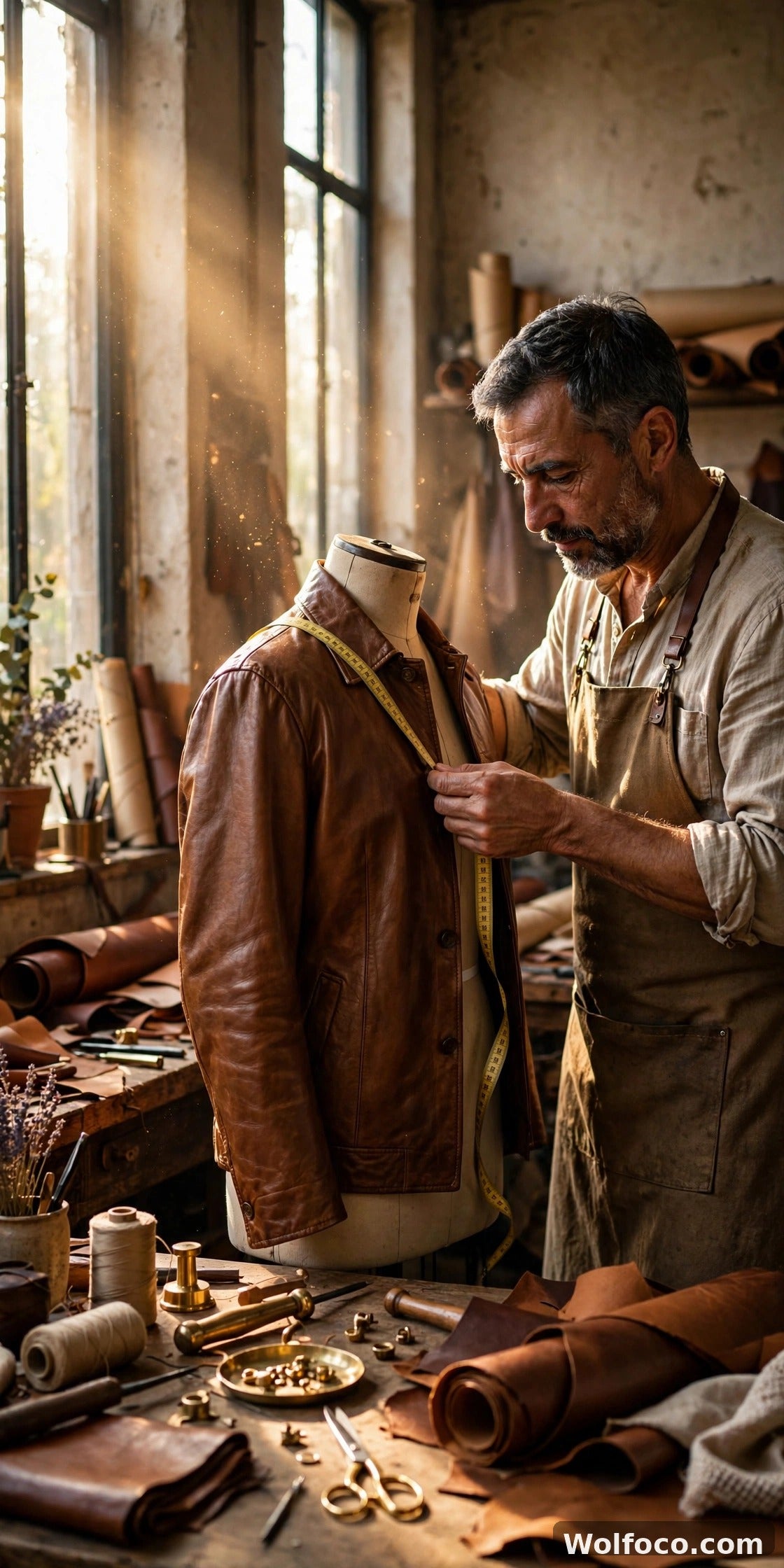

Quick answer: A custom leather jacket typically takes 3 to 8 weeks from measurements to delivery. The range comes down to the maker: pattern drafting and your approval rounds take 1–2 weeks, cutting and hand construction another 2–4, and shipping the rest. Rush options exist, but they usually cost more and limit your choices.
You've found the maker. You've picked the leather, the lining, the hardware. And now comes the hardest part of ordering a custom leather jacket: waiting for it.
Ask "how long does a custom leather jacket take" and you'll get answers everywhere from ten days to four months. That's not because anyone is lying — it's because "custom" covers everything from adjusted stock patterns to a jacket built from scratch around your body. As a rule of thumb, plan on 3 to 8 weeks: the maker's backlog, your approval rounds, and the jacket's complexity set where you land in that range. What follows is the honest version: what actually happens at each stage, how long each one realistically takes, what makes orders run late, and how to tell whether the wait is worth it.
Stage 1: Measure (1–3 Days)
Everything starts with measurements. You'll take them yourself with a tape, follow a video guide, or work through a fit consultation. This stage is mostly in your hands — it takes as long as you take.

Accurate measurements are the foundation — most fit problems trace back to this step.
The part people underestimate: measurement review. A good maker doesn't just accept your numbers — they sanity-check them against each other. If your chest and waist measurements imply a body shape that doesn't match your shoulder width, they'll ask you to re-measure before anything gets cut. That back-and-forth is a feature, not a delay. Every day spent here saves a remake later.
If you're unsure how to measure properly, our complete measuring guide walks through every number a maker needs, in order.
Stage 2: Approve (1–2 Weeks)
Once measurements are in, the maker drafts or adjusts your pattern — the paper template every panel of your jacket will be cut from. For true made-to-measure, this means adapting a base pattern to your body: lengthening a torso, widening shoulders, accounting for posture.
Then comes approval. You'll typically see a pattern sketch, a digital mockup, or a list of proposed adjustments, and you sign off — or request changes. Each round of changes adds days, because the pattern has to be re-drafted and re-checked. Most jackets need one to two rounds. If you change the design itself mid-stream (different collar, new pockets), expect the clock to restart on this stage.
Tip from people who've been through it: approve carefully but decisively. The makers who take longest here are usually the ones whose customers keep tweaking.
Stage 3: Cut (2–5 Days)
Cutting is where your jacket becomes physical. The maker selects hides — matching grain, color, and thickness across panels so the finished jacket looks like one garment, not a patchwork — then lays out the pattern and cuts.

Hide selection matters as much as cutting — panels must match in grain and tone.
This stage is short on paper and impossible to rush in practice. Leather is a natural material; a hide has thick and thin areas, scars, and stretch zones. A careful cutter works around the flaws and places the best leather where the jacket takes the most stress — shoulders, elbows, seat of the arms. That's a day or two of skilled judgment no machine has replaced.
Stage 4: Stitch (1–3 Weeks)
Construction is the longest single stage, and the one that varies most. A leather jacket has dozens of panels, and each seam is stitched on heavy machinery that moves slowly by design — too fast and the needle skips or the leather puckers.

Each seam is stitched slowly on heavy machinery — speed here ruins leather.
What stretches this stage: complexity and queue. Quilting, perforations, contrast stitching, and custom linings each add operations. And your jacket is rarely the only one on the bench — makers work in batches, and your place in line was set when you ordered. This is also why "rush" fees exist: you're not paying for faster sewing, you're paying to jump the queue.
Stages 5–6: Quality Check & Delivery (1–3 Weeks)
Before a custom jacket ships, it should be inspected the way you'd inspect it: seams checked, zippers run, snaps tested, edges finished, lining examined, and the whole garment compared against your approved measurements. Allow 2–5 days for this.

Final inspection catches what the bench misses — zippers, snaps, seams, measurements.
Sometimes this stage finds something. A seam that doesn't sit right, a zipper that catches. When that happens the jacket goes back to the bench, and a few days get added. That's good news disguised as a delay — the alternative is the flaw arriving at your door.
Then comes shipping: the most predictable stage and the one most people forget to count. Domestic delivery is usually under a week; international runs one to two, plus customs clearance that nobody controls. Leather jackets are heavy and bulky, so they ship in larger boxes with slower, cheaper methods unless you pay for speed. Factor 3–14 days for delivery, especially internationally.

The last mile counts too — factor shipping into your timeline, especially internationally.
Thinking custom? The fit starts with your measurements.
Read our custom ordering guide, see a made-to-measure style in the teal cafe racer, then browse the jackets worth customizing →
What Delays Orders — and When Rush Is Worth It
Most late custom jackets are late for the same handful of reasons. All of them are avoidable:
Slow measurement approval. The maker asks for a re-measure and you take a week to reply. Keep your tape handy for the first few days after ordering.
Design changes mid-build. Swapping the collar after the pattern is approved means re-drafting, re-cutting, and sometimes re-ordering hardware. Finalize the design before approval, not after.
Hide availability. Exotic colors and unusual finishes aren't always in stock. If your heart is set on a rare leather, ask about availability before you pay — not after.
Holiday and wedding seasons. Makers get slammed before the holidays and wedding season, same as every craft trade. Ordering in the off-season is the simplest speed hack there is.
Vague communication. "Make the sleeves a bit shorter" means nothing. Give numbers. Every clarification round costs days.
When none of that helps and you have a hard deadline, many makers offer rush production — typically 20 to 50 percent on top. Here's what you're actually buying: your jacket jumps the production queue. The sewing doesn't go faster; the waiting between stages disappears.
Rush is worth it for a wedding, a trip, an event. It is not worth it when you're just impatient, because rushed orders usually come with strings: fewer approval rounds, no design changes, limited leather choices. The fit guarantee that makes custom worth it gets thinner when the process gets faster. Ask any maker offering rush two questions: does the approval process stay the same, and what happens if the rushed jacket doesn't fit? The answers tell you whether the rush is real or just a surcharge.
Red Flags: Promises That Should Worry You
Not every "custom" jacket is custom, and the timeline is the tell:
"Ships in 48 hours, fully custom." A jacket cut to your measurements cannot be cut, stitched, and quality-checked in two days. What's shipping is a stock jacket in your approximate size — made-to-measure in name only.
No approval step. If the maker never shows you a pattern or mockup for sign-off, there is no custom pattern. Real custom work always includes your approval.
No measurement review. A maker who accepts any numbers without question will cut any numbers without question — and you'll own the result.
"Unlimited revisions, no extra time." Revisions take time. A maker promising otherwise is promising something they can't deliver, and something else in the process is paying for it.
Is It Worth the Wait?
Here's the math that matters. A good off-the-rack leather jacket lasts a decade. A custom one fits like it was always yours from day one — no break-in negotiations, no tailor visits, no "close enough." Spread over ten years of wear, the extra four to six weeks of waiting cost you nothing and the fit pays you back every time you put it on.
The wait also does something psychological: you chose every detail, you watched it come together, and by the time the box arrives, it's already your favorite jacket. That's not something a warehouse shelf can ship in 48 hours.
If you're ready to start, our custom leather jacket ordering guide covers the whole process from first measurement to final approval, and our fit guide shows what a proper fit actually looks like — useful whether you go custom or off the rack.
Frequently asked questions
How long does a custom leather jacket take on average?
For genuine made-to-measure, the typical range is 3 to 8 weeks from finalized measurements to delivery. Pattern drafting and approvals take 1–2 weeks, cutting and construction 2–4, and shipping the rest. Simpler designs from makers with short queues land near 3 weeks; complex builds in busy seasons approach 8.
Can I get a custom leather jacket in 2 weeks?
Honestly, probably not — not a real one. Two weeks doesn't allow for pattern drafting, approval rounds, careful cutting, and hand construction. Makers advertising 2-week "custom" are usually selling adjusted stock jackets. If you need something fast, ask about rush production, but expect fewer approval rounds and limited options.
What is the longest part of making a custom leather jacket?
Construction — the actual stitching — at 1 to 3 weeks. Leather has to be sewn slowly on heavy machinery, and your jacket shares the bench with other orders. The approval stage runs second at 1–2 weeks, driven mostly by how many revision rounds your fit needs.
Does a more expensive custom jacket take longer?
Not necessarily, but complexity correlates with both. Quilting, perforations, contrast stitching, and exotic leathers add production steps and sometimes material lead times. A simple custom jacket from a premium maker can arrive faster than a complex one from a budget shop.
What should I do while waiting for my custom jacket?
Stay reachable for the first two weeks — that's when measurement questions and approval requests land, and fast replies keep your order on schedule. After approval, there's nothing to do but wait. Resist the urge to request changes mid-build; that's the single biggest cause of delays.
Is a custom leather jacket worth the wait compared to off-the-rack?
If fit matters to you, yes. Off-the-rack jackets fit an average body you don't have; custom fits yours. Over a decade of wear, the extra weeks of waiting are invisible and the fit is daily. The one case for off-the-rack: you need a jacket this week and fit is "good enough."
Ready when you are. Start with measurements that are actually accurate — our measuring guide — then explore the Wolfoco jacket collection →

