
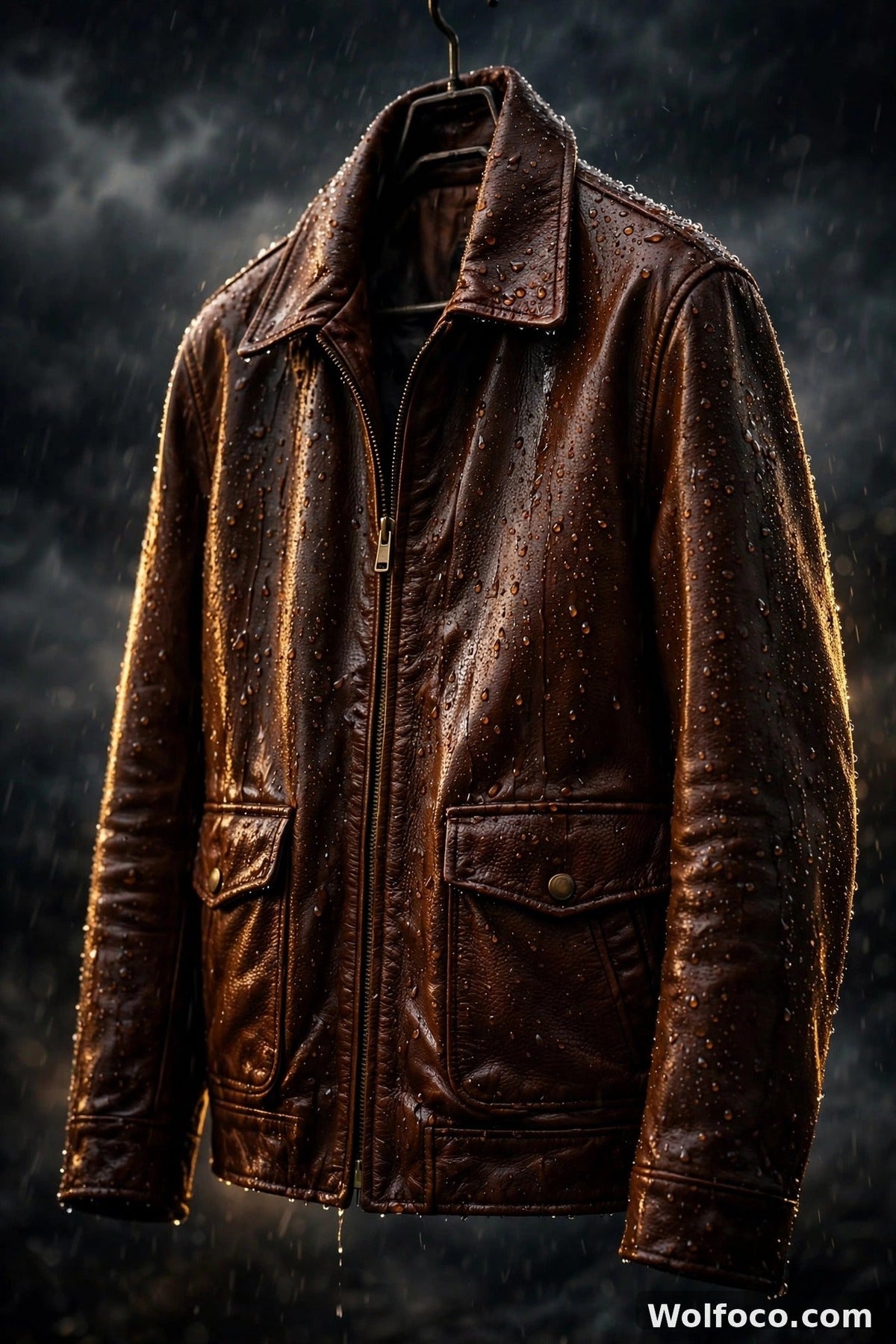

Quick answer: First identify the stain: pale rings are water spots, white crusty lines are salt, dark blotches are dye bleed. Blot (never rub) with a soft dry cloth, hang the jacket on a broad hanger, and let it dry slowly at room temperature away from heat. Treat water spots by lightly dampening the whole panel with distilled water so it dries evenly, treat salt with a 2:1 water–white-vinegar dab, then condition the leather once fully dry.
You walked in from the rain, hung up your jacket, and came back to pale rings staring at you from the shoulders. Your stomach dropped. I know that feeling — a good leather jacket is an investment, and water marks look like damage.
Here is the good news: most water stains on leather are not damage at all. They are mineral deposits and uneven drying, and they come out with patience and the right sequence. What ruins jackets is not the rain — it is the panic afterward. The hair dryer, the radiator, the aggressive scrubbing. This guide will walk you through exactly what to do, in order, depending on the kind of stain you are looking at.
First, diagnose your stain: not all water marks are the same

Pale rings with darker edges — classic water spots. The fix is evening out the drying, not scrubbing the ring.
Look closely at the mark before you touch it. You are dealing with one of three things, and each gets a different treatment:
Water spots. Pale rings or tide lines with slightly darker edges, usually on the shoulders, hood, or back where rain sat longest. Tap water and rain carry dissolved minerals; as the leather dries unevenly, those minerals settle into a visible ring. This is the most common mark and the easiest to fix.
Salt lines. White, crusty, almost chalky streaks — common in winter when road salt splashes up, or if you wore the jacket near the ocean. Salt is hygroscopic, so it keeps pulling moisture and can stiffen the leather if left alone. It needs a different approach than plain water spots.
Dye bleed or dark blotches. Irregular dark patches where water has moved the dye around, more common on lightly finished or vegetable-tanned leathers. These are stubborn. You can often improve them a great deal, but deep dye migration sometimes needs a professional's hands.
If you are unsure which one you have, treat it as a water spot first — that method is the gentlest and will not make anything worse.
What you'll need (gather this before you start)

A small kit covers nearly every water-stain rescue: conditioner, a soft brush, clean cloths, and distilled water.
You do not need much, and you probably own most of it: two or three soft, clean, undyed cloths (old cotton t-shirts are perfect), a broad sturdy hanger, distilled water (a bottle from any grocery store — it leaves no mineral rings of its own), white vinegar if you suspect salt, and a quality leather conditioner. Skip anything labeled "mink oil" or "neatsfoot" for this job unless you know your jacket's finish — a neutral leather conditioner or balm is the safe universal choice.
Step 1: Blot the moisture — never rub

Press and lift, press and lift. Rubbing grinds minerals into the grain.
If the jacket is still damp, press a dry cloth firmly against the wet areas and lift straight off. Repeat with dry sections of the cloth. Rubbing is the enemy here — it pushes water and minerals deeper into the grain and can scuff the finish. Work from the outside of each wet patch inward so you do not spread the damp area further. If the lining is wet, turn the jacket inside out for a while and blot the lining too; trapped moisture is what causes that musty smell later.
Step 2: Dry it slowly at room temperature

A broad hanger, a ventilated room, and time. This unglamorous step does most of the work.
Hang the jacket on a broad, sturdy hanger — never a wire one, which will dent wet shoulders — and leave it in a ventilated room at normal room temperature. Stuff the sleeves loosely with dry towels so they keep their shape. Then walk away. Most jackets need 24 to 48 hours. I know that feels like doing nothing, but slow, even drying is the entire secret: the majority of water spots form because one area dried faster than the rest. For the full wet-jacket protocol, including what to do about the lining, see our guide on what to do when a leather jacket gets wet.
Step 3: Treat the stain by type
Water spots: This sounds backwards, but it is the professional method: a water spot is a boundary between wet-dried and dry leather. You erase the boundary by making the whole panel uniformly, lightly damp — then letting it dry uniformly.
Dampen a clean cloth with distilled water, wring it until it is barely moist, and wipe the entire panel (the whole shoulder, the whole sleeve — not just the ring) in long, even passes. You want the leather evenly misted, not wet. Then hang it back up and let it dry slowly exactly as in Step 2. When it dries as one uniform surface, the ring has nothing to contrast against and disappears. On most finished leathers, one pass does it. If a faint outline remains after full drying, repeat once more — but never more than twice before conditioning, or you risk over-wetting.
Salt lines: Salt needs chemistry, not just water. Mix two parts distilled water with one part plain white vinegar. Dampen a cloth with the solution, wring it well, and dab — do not rub — along the salt lines. The mild acid dissolves the salt crystals without attacking the leather the way plain scrubbing would. Follow immediately with a second cloth dampened with plain distilled water to lift the residue, then dry slowly on the hanger. Salt left in leather keeps drawing moisture for weeks, so do not skip the follow-up wipe. If the leather feels stiff afterward, that is normal — the conditioner in the next step restores the suppleness.
Step 4: Condition to finish — this is the before-and-after moment

Left: spotted and thirsty. Right: the same leather after treatment and conditioning. The conditioner is what locks in the rescue.
Once the jacket is completely dry — and I mean completely, not "mostly" — apply a thin, even coat of leather conditioner with a soft cloth, working in small circles. Water, even when it leaves no visible mark, strips natural oils from the hide. Conditioning replaces them, evens out the color, and restores the water resistance the jacket had before the rain. Buff gently after 15 minutes. This is the step people skip, and it is the difference between a jacket that looks rescued and one that looks untouched.
Rain happens. A jacket built for decades shrugs it off.
Wolfoco jackets are cut from full-grain hides and finished to take real weather — and every one can be made to your exact measurements. Shop leather jackets →
Favorites: the Women's Brown Leather Motorcycle Jacket and the Men's Teal Leather Cafe Racer.
What NOT to do (read this before you improvise)
Panic causes more ruined jackets than rain ever has. Do not do any of these, no matter how tempting:
No hair dryers, ever. Concentrated heat cooks the proteins in leather, leaving it brittle, shrunken, and cracked. A jacket dried with a hair dryer often looks fine for a week, then the finish starts flaking at the stress points.
No radiators, heaters, or direct sunlight. Same reason, slower. Heat drying creates exactly the uneven drying that causes tide marks — and on a larger scale.
Do not soak the jacket to "even it out." Lightly misting a panel is controlled; submerging or saturating leather swells the fibers and can permanently warp the shape.
No household soap, dish soap, or all-purpose cleaners. Their pH strips the tanning oils and the finish. If you would not wash your face with it, do not put it on your jacket.
Do not scrub at the ring. Abrasion drives minerals deeper and burnishes a shiny patch into the grain that is harder to fix than the original spot.
A final note on professionals: be honest with yourself at this point. If dye has bled into large dark blotches, if the leather has gone stiff and cardboard-like after a real soaking, or if the jacket has sentimental or significant monetary value, take it to a leather specialist — not a regular dry cleaner, most of whom will refuse it or make it worse. A cobbler or leather repair shop can re-dye panels, replace linings, and recondition hides with tools you cannot buy retail.
For scuffs and surface marks that remain after the water treatment, our guide to fixing leather scratches, scuffs, and water spots covers the next level of repair. And once your jacket is rescued, storing it properly keeps it from ever getting musty between wears.
Frequently asked questions
Can water stains be removed from a leather jacket?
Yes, in most cases. Pale water spots and salt lines respond well to the blot, slow-dry, treat, and condition sequence in this guide. Only deep dye bleed or leather that has been heat-damaged is difficult to fully reverse, and even those can usually be improved by a professional.
Why does water leave spots on leather?
Water itself is not the problem — the dissolved minerals in it are. As a wet patch dries faster at its edges than its center, minerals concentrate along the drying boundary and leave a visible ring, exactly like the tide line in a bathtub.
Can I use a hair dryer to dry my leather jacket?
No. Concentrated heat damages leather's protein structure, causing shrinkage, brittleness, and cracking that often appears days later. Always air-dry at room temperature on a broad hanger, away from radiators and direct sun.
Will water ruin a leather jacket permanently?
A single rain shower will not ruin a quality leather jacket. Permanent damage comes from heat drying, prolonged soaking, or salt left untreated. Treated promptly and correctly, most jackets come through rain looking as good as before.
How do you get salt stains out of a leather jacket?
Dab the salt lines with a cloth dampened in a 2:1 solution of distilled water and white vinegar, follow with a clean water wipe to remove residue, dry slowly at room temperature, and condition once fully dry.
Should I condition my leather jacket after it gets wet?
Yes — always, once it is completely dry. Water strips natural oils from the hide even when it leaves no visible mark. A thin coat of leather conditioner restores suppleness, evens out color, and rebuilds water resistance.
Rain is part of a leather jacket's life — the patina it builds over years of weather is half the appeal. Treat the stains calmly, condition afterward, and your jacket will be back on your shoulders in a couple of days. And if this rescue has you thinking about a jacket cut exactly for you, explore the Wolfoco leather jacket collection — every piece can be made to your measurements.

