
Reviewed by the Wolfoco Product Standards Team.

The short answer
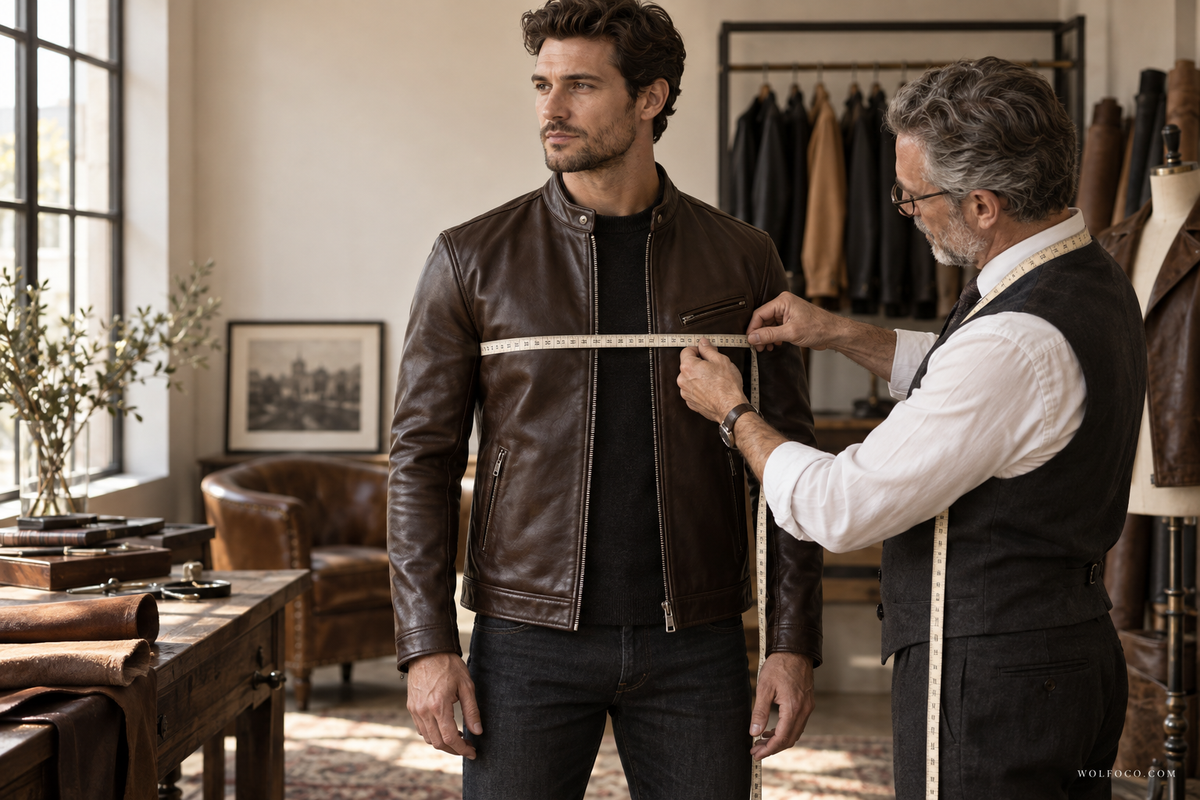
To measure for a leather jacket, use a flexible cloth tape and record your chest, natural waist, shoulder width, sleeve length, back length and—when the pattern requires it—hips and upper arm. Wear the layer you expect to put under the jacket, stand naturally and keep the tape level without pulling it tight. Take every measurement twice. Then compare your body measurements with the specific product size chart; do not assume that a familiar letter size will fit the same across different silhouettes.
A body measurement describes you. A garment measurement describes the finished jacket. They are not interchangeable. A jacket must be larger than the relevant body measurement to provide wearing ease, but the correct amount depends on the design, leather, lining and intended layers. A close café racer, a structured biker jacket and a winter-weight bomber should not be assessed with one universal allowance.
If you are between sizes, have an uncommon shoulder-to-waist proportion, or want a very specific length, ask for a custom-fit review before ordering. Wolfoco can evaluate a complete measurement set, but the final production specification should always be confirmed in writing.
Principal product CTA: Explore Wolfoco leather
jackets
Consultation CTA: Request a Wolfoco
custom-fit consultation
Why accurate leather-jacket measurements matter
Leather behaves differently from a soft sweatshirt or loose overshirt. A finished leather jacket has structure. Seams, facings, zippers, lining, pockets and sometimes padding all influence how it moves. Natural leather may relax in high-motion areas with wear, but it should not be treated as a substitute for choosing the right pattern and size. A jacket that is substantially too small will not reliably stretch into the correct fit, and aggressive stretching can distort seams, hardware and surface finish.
The most common online sizing mistake is choosing only from height, weight or a usual T-shirt size. Those details provide context, but they do not identify shoulder slope, chest depth, arm length, waist proportion or posture. Two people of the same height and weight can need different jacket sizes. Direct measurements reduce that uncertainty and give a custom team information it can actually use.
Good measurements also improve communication. Instead of saying “I normally wear a large,” you can say, “My chest is 42 inches, shoulder width is 18.5 inches and the reference jacket I like measures 23 inches pit to pit.” That creates a clearer, testable starting point.
What you need before measuring
Prepare a flexible tailor’s tape, a mirror, a notes app or measurement sheet, and preferably a second person. A rigid construction tape is difficult to keep level around the torso and can produce misleading results. Use inches or centimeters consistently; record the unit beside every number.
Wear a fitted T-shirt for a close jacket or the sweater you expect to layer beneath a cold-weather jacket. Empty bulky pockets. Remove thick outerwear. Stand in a relaxed posture with your feet evenly planted. Do not expand your chest, pull in your stomach or force your shoulders backward. The goal is to capture the body the jacket must fit during normal use.
Take each measurement twice. If the two results differ, reset the tape and take a third reading. For custom work, photographs of the tape position can help the maker identify an incorrect measuring path, but never include private documents or unnecessary personal information.

Body measurements versus jacket measurements
This distinction solves much of the confusion around size charts.
Body measurements are taken around or across the person. A 42-inch body chest means the tape measures 42 inches around the fullest part of the torso. Garment measurements are taken on a finished jacket laid flat or positioned naturally. A jacket listed with a 46-inch garment chest is not a size for a 46-inch body; it includes space for the body, movement, clothing and construction.
Some product charts present body ranges, while others present finished garment dimensions. Read the heading and instructions before comparing. If the chart says “pit to pit,” it usually describes a flat garment width. Doubling that number gives an approximate circumference, but thick leather, lining and curved shaping mean it is not identical to a body measurement.
Never add ease to a garment chart twice. If a brand chart already specifies the finished jacket chest, compare it with a jacket that fits you. If it specifies body chest ranges, compare it with your body. When a chart is unclear, ask the seller to explain which convention it uses.
The six core measurements
| Measurement | Where to measure | Tape position | Common mistake |
|---|---|---|---|
| Chest | Fullest part of chest and shoulder blades | Level, comfortably touching | Pulling tight or measuring too high |
| Natural waist | Narrowest torso point or where the the body bends | Level and relaxed | Using trouser waistband automatically |
| Shoulder width | Shoulder point to shoulder point across upper back | Follows natural back contour | Measuring sleeve seam of a poor-fitting shirt |
| Sleeve length | Shoulder point over slightly bent elbow to wrist bone | Along outside of arm | Measuring a straight, rigid arm |
| Back length | Base of neck to intended hem | Vertical along center back | Starting at shirt collar edge |
| Hips/seat | Fullest point around seat when jacket length reaches it | Level around body | Skipping it for long jackets |
The chart is a method summary, not a universal size chart. Product sizing must still be checked against the cut being purchased.
1. How to measure chest circumference
Ask the wearer to let both arms rest naturally. Wrap the tape around the fullest part of the chest, under the armpits and across the shoulder blades. From the side, check that the tape is approximately parallel to the floor. It should touch the clothing without compressing the body. The wearer should be able to breathe normally.
Do not measure only across the front. Do not place the tape directly under the armpit if the fullest chest point is lower. Avoid adding an extra inch “for safety”; record the true body number and let the size chart or maker account for ease.
For a fuller chest or pronounced shoulder blades, take a second high-chest measurement above the fullest point. This can help a custom maker distinguish overall chest circumference from front/back distribution.

Fit action: Compare the result with the body-chest range on the product page. If only garment chest is provided, compare the jacket with a reference jacket and ask how much ease the intended design contains.
2. How to measure natural waist
The natural waist is often above the belt line. Bend gently to one side and note where the torso creases; measure around that level while standing normally again. Keep the tape horizontal and do not hold the stomach in.
For a cropped or straight café racer, waist measurement helps determine whether the hem can close comfortably. For a shaped women’s jacket, both natural waist and the intended hem circumference can be important. For a long coat or jerkin, hips or seat may matter more than waist at the lower edge.
If the jacket will be worn over a sweater, take the measurement over that sweater and tell the maker what you wore. Do not silently combine a body measurement taken over a T-shirt with a request for heavy winter layering.
3. How to measure shoulder width
Find the bony shoulder points where a well-positioned sleeve seam would sit. Measure across the upper back from one point to the other, following the natural contour rather than pulling the tape in a straight line through the air. A helper is strongly recommended.
Shoulder fit controls much of the jacket’s appearance. If the shoulder is too narrow, the sleeve head may pull inward, the chest can feel restricted and the collar may lift. If it is too wide, the seam drops down the arm and the upper body can look collapsed. Leather can soften, but a misplaced shoulder seam will not migrate to the correct anatomical point.

For sloped or square shoulders, photographs from the front, side and back may help during custom review. The number alone does not fully describe shoulder angle or posture.
4. How to measure sleeve length
Place the tape at the shoulder point. Let the arm hang naturally with a slight bend at the elbow. Run the tape along the outside of the arm, over the elbow, to the wrist bone or preferred cuff point. Record which endpoint you used.
Some tailoring systems measure from the center back neck across the shoulder and down to the wrist. Others measure only shoulder point to wrist. These methods produce different numbers. Follow the product’s instructions exactly and label the method when sending custom measurements.
The ideal visible cuff position depends on design and riding posture. A motorcycle-oriented jacket may need additional functional reach, while a fashion café racer can finish closer to the wrist. If you will ride in the jacket, test arm extension in a similar garment and tell the maker.

Shopping action: Compare men’s leather jacket silhouettes or browse women’s leather styles.
5. How to measure back length
Locate the prominent bone at the base of the neck. Measure vertically down the center back to the point where you want the jacket to finish. Keep your posture natural. Ask a helper to hold the start point so the tape does not drift.
Jacket length changes both function and proportion. A café racer commonly ends near the belt area; a bomber’s ribbed waistband may sit differently; a blazer or coat extends farther. The same numeric back length can look different depending on torso length and rise of the trousers.

When ordering custom, provide both the body measurement and the back length of a jacket whose hem position you like. This gives the maker an anatomical reference and a preference reference.
6. How to measure hips, seat and upper arm
For any jacket that extends over the fullest part of the seat, wrap the tape around the widest point and keep it level. A long jacket can fit the chest perfectly and still fail to close at the lower hem if this dimension is ignored.
Measure upper arm or biceps around the fullest point with the arm relaxed. If the design has slim sleeves, padding or heavy layering, this measurement becomes important. Do not flex unless the maker specifically requests a flexed measurement.
Other custom systems may request neck, wrist, front chest width, back width, armhole, front length and height. Provide them only with clear instructions. Complex tailoring measurements are easy to take incorrectly without a trained helper.
How to measure a jacket you already own
A well-fitting reference jacket can be extremely useful. Close its zipper or buttons, smooth it on a flat surface without stretching it and record:
- Pit-to-pit width, measured straight across below the armholes.
- Shoulder width, seam to seam across the back.
- Sleeve length, shoulder seam to cuff along the outer sleeve.
- Center-back length, base of collar to hem.
- Waist and hem widths at defined points.
- Upper-arm width, measured across the sleeve at a consistent distance below the armhole.
Photograph the tape in position and identify the garment being measured. A denim jacket, padded motorcycle jacket and unlined leather overshirt can have different construction thicknesses even if their outside widths appear similar.
Do not use a jacket that already fits badly as the only reference. Note what you want changed: “same sleeve length, 1 inch more chest room, 0.5 inch narrower shoulder” is more informative than copying every dimension unquestioningly.
Choosing standard sizing or custom sizing
Standard sizing is usually appropriate when your measurements fall comfortably within one size range and your proportions align with the product chart. It is simpler, faster and often eligible for the store’s ordinary return rules.
Custom sizing becomes valuable when chest, waist, shoulders and sleeves point to different sizes; when you have a notably long or short torso; when posture or mobility needs require adjustment; or when a design must end at a very precise point. Custom does not mean “guess from height and weight.” It requires a complete, internally consistent specification.
Before approving custom production, request a written summary of the agreed measurements, leather, color, lining, hardware, pockets, personalization, processing estimate and return eligibility. Correct any unit errors before approval. Save that record.
Consultation action: Start a custom-order conversation with Wolfoco.
Fit differences by jacket style
Café racer
A café racer is usually clean and relatively close through the torso. Shoulder placement and sleeve length are visually prominent because the design has few distractions. It should zip without pulling the front into horizontal stress lines. You should be able to reach forward, sit and bend your elbows without the collar choking or the back riding excessively.
Compare café racer, bomber and biker silhouettes.
Biker jacket
An asymmetrical biker jacket may overlap at the front and include belts, lapels or gussets. Judge it in both open and closed positions. Hardware and multiple leather layers can make the torso feel firmer. If intended for riding, evaluate posture, protection and sleeve reach with the equipment you will actually use.
Bomber jacket
A bomber typically allows more body volume and uses a ribbed or elasticated hem. Measure the body location where that hem will sit. Too much length can cause bunching above the waistband; too little can expose layers when reaching. Sleeve volume should support the intended insulation without overwhelming the cuff.
Blazer or tailored jacket
A leather blazer depends on shoulder line, button stance, waist shaping and length. Measure chest, waist, seat, shoulders, sleeves and both front and back length. If a tailored silhouette is the goal, professional assistance is worthwhile.
Long coat or jerkin
For longer garments, include hips or seat and intended hem length. Historical or costume-inspired jerkins can use unusual closures, side lacing and layered shapes. Confirm whether the product is fashion wear, performance costume or protective equipment; these purposes require different fit decisions.
How much ease should a leather jacket have?
There is no single correct number for every jacket. Ease depends on pattern, leather thickness, lining, insulation, posture and desired silhouette. A size chart prepared for one product is more trustworthy than a universal internet rule.
Use this decision tool:
| Intended use | Base layer during measurement | Fit priority | What to verify |
|---|---|---|---|
| Close fashion fit | Fitted T-shirt | Clean shoulder and torso line | Zips comfortably; no severe pulling |
| Everyday layering | Shirt or light knit | Balanced shape and movement | Reach, sitting and elbow bend |
| Cold-weather wear | Actual sweater | Layering room | Armhole, upper arm and hem comfort |
| Riding posture | Riding layers | Forward reach and coverage | Sleeve reach, back rise and safety needs |
| Custom event/costume | Planned underlayers | Silhouette and range of motion | All closures and performance movements |
If the product page does not state whether dimensions are body or garment measurements, ask before ordering. If you are between sizes, compare the measurements most difficult to alter—usually shoulders, chest and sleeve geometry—rather than choosing only by waist.
The movement test
Measurements predict fit, but movement confirms it. Zip the jacket and perform ordinary actions: reach forward as if holding a steering wheel, cross your arms gently, raise each elbow, sit, turn your torso and place your hands in the pockets. The jacket should resist slightly because leather has structure, but it should not restrict breathing, force the zipper apart or cause sharp pressure at the neck or armholes.
Some hem lift during forward reach is normal. Severe riding-up, a collar pulled backward or deep diagonal stress lines can indicate imbalance. Also inspect the back when arms return to neutral; excess fabric that never settles may point to too much volume or incorrect shoulder width.

Ten mistakes that cause inaccurate sizing
- Choosing from height and weight alone.
- Confusing body measurements with finished garment measurements.
- Measuring over a thick layer without telling the maker.
- Pulling the tape tight to obtain a smaller number.
- Adding homemade ease before submitting body measurements.
- Measuring sleeve length with the arm rigidly straight.
- Using the trouser waistband as the natural waist automatically.
- Skipping hips for a jacket that extends over the seat.
- Mixing inches and centimeters in one form.
- Approving custom production without checking the written specification.
The safest rule is to record exactly what was measured, how it was measured and what clothing was worn. Clear context is as important as the number.
A practical measurement record
Copy this list into your notes:
- Measurement unit: inches / centimeters
- Base layer worn:
- Chest circumference:
- High chest, if requested:
- Natural waist:
- Hips/seat:
- Shoulder width:
- Sleeve length and method:
- Upper arm:
- Center-back length:
- Height, for context:
- Preferred jacket style:
- Intended layers:
- Reference jacket measurements:
- Mobility or posture considerations:
- Desired fit: close / regular / layered:
Before sending, check that related dimensions make sense together and attach tape-position photos if requested. Keep a copy of the submitted values.
Frequently asked questions
Should I size up in a leather jacket?
Not automatically. Use the product-specific chart and intended layers. Size up only when your measurements, layering needs or preferred silhouette support that choice. An unnecessarily large shoulder can damage the intended shape.
Can a tight leather jacket stretch to fit?
Leather can relax in high-motion areas, but it should not be expected to correct a materially wrong size. Seams, lining, zippers and structured panels limit change. Start with a jacket that closes and permits normal movement.
Do I measure my chest with a jacket on?
For a body measurement, wear only the intended base layer. For a garment measurement, measure a separate jacket laid flat. Label the two sets clearly.
What if my chest and waist indicate different sizes?
Prioritize the product’s fit notes and ask the seller. Depending on the pattern, a custom adjustment may be better than selecting a size that fits one area but fails in another.
How do I measure sleeve length by myself?
It is difficult to hold the correct shoulder point and follow a slightly bent arm alone. Use a helper when possible. Alternatively, measure a well-fitting jacket and clearly state that it is a garment measurement.
Where should a leather jacket sleeve end?
For everyday fashion jackets, the cuff commonly finishes around the wrist bone, but style and riding posture can change the target. Confirm the design’s intended sleeve position.
Should I measure in inches or centimeters?
Either is suitable if used consistently. Do not convert repeatedly. Record the unit beside every value and verify any conversion before approving custom work.
What measurements are most important for a café racer?
Chest, shoulder width, sleeve length, waist or hem, and back length are central. Because the silhouette is clean and close, small proportional errors are easy to see.
Is custom sizing always better?
No. A standard size is often the best choice when the chart aligns with your body, especially when returns and exchanges are important. Custom sizing is useful when proportion or preference cannot be served well by standard grading.
Can a tailor alter a leather jacket later?
Some alterations are possible, but leather retains needle holes and complex work can be expensive. Shoulders, armholes and major zipper changes are especially involved. Accurate ordering is preferable to relying on later alteration.
How do I know whether a size chart lists body or garment measurements?
Read its label and instructions. Body charts usually provide wearer ranges; garment charts may say “finished measurement,” “pit to pit” or show dimensions of the item. Ask the seller if there is any ambiguity.
What should I send for a Wolfoco custom-fit review?
Send the complete requested measurement set, units, intended layers, preferred silhouette and relevant reference-jacket dimensions. Wolfoco should return a written specification for approval before production.
Final checklist before ordering
Measure twice, identify whether the chart uses body or garment dimensions, account for the actual layer you will wear, and assess the jacket style rather than applying a universal rule. Protect the fit at the shoulders and chest, confirm sleeve and back length, and include hips when the hem reaches the seat. For custom work, approve a written specification rather than relying on informal messages.
For a broader visual assessment, read How Should a Leather Jacket Fit?. When you are ready to compare real pieces, shop Wolfoco’s current leather collection. If standard sizing does not match your proportions, request a custom-fit review before placing the order.
Editorial note: This guide provides general apparel-measurement education. Product patterns and size charts differ. Motorcycle or protective clothing should be selected according to its manufacturer’s safety and fit instructions.
Search-topic map used naturally in this guide
how to measure for a leather jacket; leather jacket size guide; leather jacket measurements; chest measurement for jacket; shoulder width measurement; sleeve length measurement; back length measurement; leather jacket fit guide; café racer jacket sizing; biker jacket sizing; bomber jacket sizing; custom leather jacket measurements; standard versus custom sizing; body measurements versus garment measurements; leather jacket size chart; how should a leather jacket fit; men’s leather jacket sizing; women’s leather jacket sizing; measure pit to pit; jacket wearing ease; leather jacket layering; leather jacket shoulder fit; leather jacket sleeve fit; leather jacket chest fit; leather jacket waist measurement; leather jacket hip measurement; upper arm measurement; reference jacket measurements; made-to-measure leather jacket; bespoke leather jacket fit; online leather jacket sizing; between jacket sizes; leather jacket movement test; leather jacket cuff length; leather jacket back length; leather jacket measurement checklist; how to size a café racer jacket; how to size a biker jacket; how to size a bomber jacket; custom-fit consultation.

