
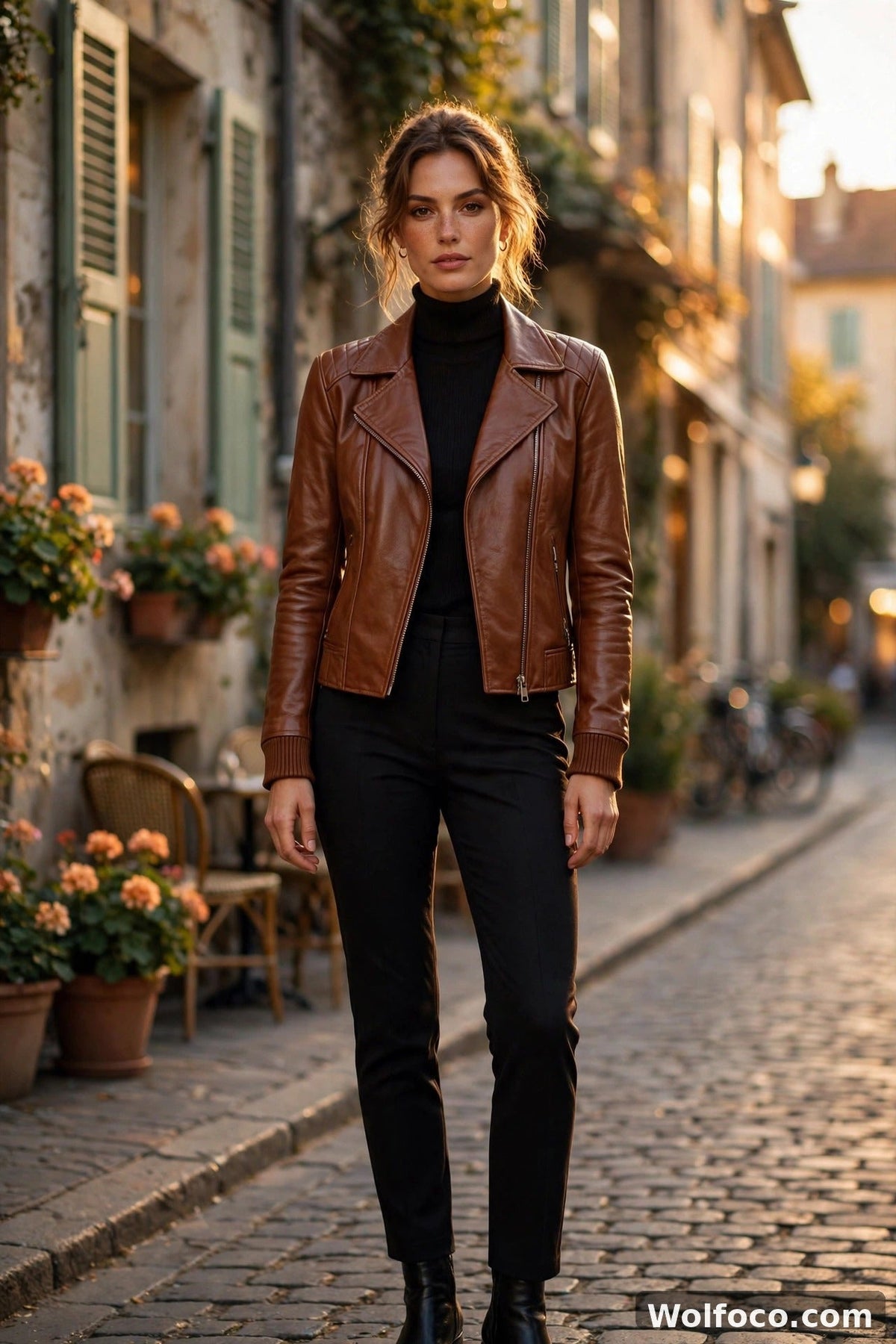

Quick answer: Measure your bust, natural waist, and shoulder width, then match those numbers to the brand's size chart — not your dress size. The jacket should zip over your bust without pulling, the shoulder seam should sit at your shoulder bone, and sleeves should end at your wrist. Between sizes? Go up for layering, down for a sleek fit.
You found the jacket. The leather is gorgeous, the style is exactly right — and then the sizing chart looks like a puzzle written in someone else's handwriting. Is a medium in leather the same as a medium in everything else? (No.) Should it feel snug? (Yes, at first.) Will it stretch? (A little, in the right places.)
Women's leather jacket sizing deserves its own guide because women's bodies don't scale the way mass-market size charts pretend they do. A jacket that fits your shoulders can pull across your bust; one that fits your bust can swallow your frame. This guide walks you through measuring, reading a chart like a tailor, and solving the fit problems that actually plague women — bust ease, shoulder slope, cropped proportions, petite and tall lengths — so the jacket you order is the jacket you keep.
Why women's leather jacket sizing is its own problem
Most size charts are drawn for a straight, sample-size body and then graded up and down. Real women's bodies have bust-to-waist ratios, shoulder slopes, and hip curves that don't scale linearly. Leather makes this harder than fabric: it doesn't drape and forgive the way wool or cotton does. A leather jacket announces every fit compromise loudly.
Three things make women's leather sizing uniquely tricky. First, bust ease — the jacket needs room across the fullest part of your bust, or it will pull, gap at the zipper, and never sit right. Second, shoulder slope — women's shoulders are often narrower and more sloped than the block a jacket was cut on, so sleeves can feel long even when the body fits. Third, proportion — cropped, waist-length, and long jackets all land differently depending on your torso length, and a chart can't tell you where your waist actually is.
The fix is to measure yourself and fit the jacket to your numbers, not to the size you wear in sweaters. Let's do it properly.
Take your three measurements (two minutes, one tape)
You need three numbers. Wear a thin top or a well-fitting bra — never a bulky sweater — and stand relaxed, not sucked in.
1. Bust. Wrap the tape around the fullest part of your bust, keeping it level across your back. The tape should be snug but not tight — you should be able to slip a finger under it. Write down the number in inches.
2. Natural waist. Find the narrowest point of your torso, usually an inch or two above your navel. Don't pull in. This matters for belted and cropped styles.
3. Shoulder width. Measure from one shoulder bone to the other across your back. This is the measurement most women skip, and it's the one that determines whether the jacket looks tailored or borrowed.

Three measurements, two minutes: bust, natural waist, and shoulder width are all you need to read any size chart like a tailor.
If you're between sizes, also note your usual jacket size in blazers — it tells you how you like your shoulders to fit, which is the hardest part of a leather jacket to alter.
Read the size chart like a tailor
Here's a standard women's leather jacket size chart. Wolfoco jackets follow standard US sizing, and most quality leather brands land within a half inch of these numbers:
| Size | Bust (in) | Waist (in) | Shoulder (in) | Sleeve (in) |
|---|---|---|---|---|
| XS | 32–33 | 25–26 | 15 | 23.5 |
| S | 34–35 | 27–28 | 15.5 | 24 |
| M | 36–37 | 29–30 | 16 | 24.5 |
| L | 38–39 | 31–32 | 16.5 | 25 |
| XL | 40–42 | 33–35 | 17 | 25.5 |
| 2XL | 43–45 | 36–38 | 17.5 | 26 |
Read it in this order of priority: bust first, shoulders second, everything else third. The bust determines whether the jacket closes. The shoulders determine whether it looks like yours. Waist and sleeve length can be worked around — a slightly long sleeve can be pushed up, and a waist with a little room looks intentional. A jacket that won't zip over your bust is unwearable, and shoulders that droop past your shoulder bone make the whole jacket look two sizes too big.
One more thing charts don't tell you: leather gives about half an inch with wear across the bust and elbows, but it does not grow in the shoulders. Fit the shoulders and bust on day one; everything else will settle in.
Bust ease: the number-one fit problem
If you've ever tried on a leather jacket that fit everywhere except it pulled into an X shape across the chest or the zipper strained, you've met the bust-ease problem. It's the single most common reason women return leather jackets.
Here's the rule: when the jacket is zipped, you should be able to pinch about an inch of leather at the side seam near your bust — that's ease, the room the jacket needs to move with you. If the leather pulls taut with white stress lines radiating from the zipper, size up. If it gapes or the zipper buckles outward, size down.

The shoulder seam should sit right at your shoulder bone, and the leather should drape smoothly across the bust — no pulling, no gaping.
Women with a fuller bust should look for styles with princess seams, a slightly A-line cut, or an adjustable waist — these are cut to accommodate curves instead of fighting them. Biker jackets with asymmetric zips are surprisingly forgiving here, because the diagonal zip line distributes tension instead of concentrating it down the center.
Shoulders and sleeve length: the tailor test
Put the jacket on and look at the shoulder seam — the line where the sleeve meets the body. It should sit exactly at the edge of your shoulder bone. If it droops onto your upper arm, the jacket is too big in the shoulders no matter how the body fits, and this is the one alteration that costs real money at a leather tailor.
Sleeves should end at your wrist bone when your arms hang relaxed. Leather sleeves run long on many women because patterns are graded from taller blocks. A half inch of extra sleeve is fine — it'll settle — but if the cuff swallows your hand, that's a size issue, not a break-in issue.
Raise your arms forward as if you're reaching for a steering wheel. The jacket should lift slightly at the hem but not ride up to your ribs, and you shouldn't feel the lining strain across your upper back. If it binds, you need more room through the shoulders and back — size up or choose a style with a bi-swing back or gusseted shoulders.
Petite, tall, and curvy: length rules
Jacket length is about your torso, not your height — but height is a decent proxy. Here's how the three main lengths behave:
Cropped jackets (ending at or above the waistband) are a petite woman's best friend — they elongate the leg line and don't overwhelm a smaller frame. On a tall woman, the same cropped cut can look accidentally short, so check where it lands against your natural waist.
Waist-length jackets (ending at the hip bone) are the universal safe choice. They work on nearly every body because they end at a natural breaking point.
Long jackets and coats (mid-thigh and below) look dramatic on tall frames and can swamp petite ones — unless the coat is cut slim through the body with a defined waist.

Cropped cuts flatter petite frames; longer coats shine on tall ones — the right length is about where the hem lands on your torso.
If you're petite, also watch the pocket and zipper placement — details scaled for a taller block can look oversized on a smaller jacket. If you're tall, check the sleeve and body measurements against the chart rather than trusting the size letter; you may need a size up purely for length.
Size up for layers or down for sleek?
This is the question every woman asks, and the honest answer is: it depends on how you'll actually wear it. A leather jacket sized to fit over a t-shirt will be snug over a chunky sweater. Decide before you order.
Size down (or take your exact size) if you want the sleek, second-skin look — the jacket as the outfit, worn over thin layers. The leather will mold to you within a couple of weeks of wear. This is the right call for going-out jackets and fitted biker styles.
Size up if this is your everyday, throw-it-over-anything jacket. You want to be able to zip it over a sweater without the shoulders binding. When trying it on, do the sweater test: wear the thickest thing you'd realistically layer under it.

Decide how you'll really wear it before you order: sleek over thin layers means your true size, everyday layering means one size up.
Between sizes with no strong preference? Take the larger size. A leather tailor can take in a body seam for far less than the cost of a jacket you never wear because it's too tight to zip.
Stop guessing between sizes. Wolfoco's women's leather jackets are cut for real curves — with detailed measurements on every product page and a made-to-measure option when off-the-rack won't do.
What NOT to do when sizing a leather jacket
Don't buy your dress size blind. Vanity sizing means your "medium" in one brand is another brand's small. Always check the inch measurements.
Don't size up "just in case." Leather doesn't shrink, and an oversized leather jacket looks sloppy in a way an oversized blazer doesn't — the stiffness works against you.
Don't trust the "it'll stretch" promise for shoulders. Leather gives across the bust and elbows with wear, but shoulder width is structural. If the shoulders don't fit in the fitting room, they won't fit in a month.
Don't ignore the zip test. Zip the jacket all the way up, sit down, and reach forward. If anything pulls, gapes, or binds in that position, it's the wrong size — showroom standing isn't real life.
Don't keep a jacket that almost fits. "Almost" is the most expensive word in leather. Returns exist for a reason; a jacket you have to talk yourself into is a jacket you'll stop wearing by spring.
When nothing off-the-rack fits: made-to-measure
Some bodies simply don't live on a size chart — a 34 bust with 17-inch shoulders, a petite torso with long arms, curves the grading never accounted for. If you've tried three sizes and none of them work, the problem isn't you; it's the chart.

Made-to-measure cuts the pattern to your actual body — bust, shoulders, torso length, and all.
Made-to-measure cuts the pattern to your measurements instead of asking your body to fit a pattern. You send your bust, waist, shoulder, and sleeve numbers plus your height, and the jacket is built around them — which also means you get to choose the leather, the lining, and the details. It costs more than off-the-rack and takes a few weeks, but for hard-to-fit women it's the difference between a jacket that sort of fits and one that looks like it was always yours. Learn exactly how to measure for a leather jacket before you order either way — the same three numbers decide everything.
Frequently asked questions
Should a women's leather jacket be tight or loose?
Snug but not tight. You should be able to zip it comfortably and pinch about an inch of leather at the side seam — that's the ease it needs to move with you. Leather molds to your body with wear, so a jacket that's slightly snug on day one is ideal; one that's tight enough to restrict movement will never become comfortable.
What size leather jacket should I get if I'm between sizes?
It depends on how you'll wear it: take the smaller size for a sleek fit over thin layers, the larger for everyday layering over sweaters. If you have no preference, go up — taking in a leather jacket is cheaper and easier than wishing you'd sized up. Always prioritize bust and shoulder fit over the size letter.
Do women's leather jackets run small?
Quality leather jackets often feel small at first because leather is stiffer than fabric — but they shouldn't be painful or impossible to zip. If a jacket in your measured size won't close over your bust, the brand runs small; if it closes but feels snug, that's normal and it will break in. Check inch measurements, not the size letter.
How should a leather jacket fit on a woman with a large bust?
Fit the bust first, then assess everything else. Look for princess seams, a slightly A-line cut, or an adjustable waist — styles designed for curves. Biker jackets with asymmetric zips distribute tension well. If the shoulders fit but the bust pulls, size up and have the waist taken in, or go made-to-measure.
What size leather jacket for a petite woman?
Start with your bust measurement on the size chart, then check proportions: cropped and waist-length jackets flatter petite frames, while long coats can overwhelm unless cut slim. Watch sleeve length — if cuffs cover your hands, the size is wrong regardless of how the body fits. Petite-specific or made-to-measure options solve persistent proportion issues.
Can a leather jacket be altered if the size is slightly off?
Taking in the body and shortening sleeves is straightforward for a leather specialist. What's expensive or impossible: changing shoulder width, letting out seams (there's no extra fabric), and fixing a bust that's too small. So buy for shoulders and bust — a tailor can handle the rest.
For more on nailing the overall silhouette, see our leather jacket fit guide and the women's styles and fit guide — then find the one that fits like it was made for you.
Two strong starting points: the Women's Black Leather Jacket in an elegant tailored cut for a classic silhouette, or the black-and-brown jacket and bag set if you want the full look in one go.
Ready for the jacket that actually fits? Browse the women's leather jacket collection — every piece lists real measurements, and made-to-measure is always an option when off-the-rack won't do.

